The ICC T20 World Cup is the international championship tournament for 20 over cricket, ran by the International Cricket Council (ICC). The tournament is usually held every 2 years, but the previous edition was held in 2016. It was not held in 2018, due to the conclusion of another ICC tournament in 2017, the ICC decided that there were too many ICC events lined up, such as the 2019 Cricket World Cup, and decided to cancel the tournament and the next edition to be in 2020. The womens edition, however, has been consistently ran on a 2 year basis since 2010, due to no such cluster of women tournaments. The 2020 edition of both the Womens and Mens are both to be held around Australia. The opportunity of hosting such a phenomenal event will allow for Australia to reap significant economic benefits, and provide a significant boost to the hospitality, travel/tourism and sport industries around the country. But “with all goods things come ‘bad things’ ” is an expression which can suite the economic situation surrounded with sporting events, which are heavily funded by the government. This is mainly due to the opportunity cost associated with hosting such major events.
—————————————————————————————————————————————————————

———————————————————————————————————————————-
TABLE OF CONTENTS
THE ECONOMIC IMPACT OF MAJOR SPORTING EVENTS
ECONOMIC IMPACT OF PREVIOUS TOURS/TOURNAMENTS
- 2015 ICC Cricket World Cup
- Big Bash League
- The Ashes / International Tours
ICC T20 WORLD CUP- 2020
- Government Support
- Opportunity Costs Associated
- Potential benefits associated with hosting the event
- Impacts on Tourism/Travel Industry
- Impacts on the Sporting Industry
- Impacts on the Hospitality Industry
- Impacts on the Media Industry
WHY THE 2020 T20 WORLD CUP WILL BE MORE SUCCESSFUL THAN THE 2015 WORLD CUP
REFERENCES
—————————————————————————————————————————————————————
The Economic Impact of Major Sporting Events
- Economic Impact in sporting events, can be simply defined as the net change in an economy resulting from a sport event. The change is caused by activity involving the acquisition, operation, development and use of sporting facilities. In turn, these generate impact on tourism, visitors’ and public spending, employment opportunities and tax revenue. Specifically, the total economic impact of expenditure, can be split into three categories, direct impact, indirect impact and induced effects.
- Direct effects are the purchases which are needed to meet the increased demand of visitors and tourists for goods and services.
- Indirect effects are the purchasing of goods and services by companies serving spectators, participants and event organisers of major sporting events. This includes upgrades on infastructure.
- Induced effects are the effects created as a result of additional employment, additional wages and other income related to hosting of major sports events that is spent in the local economy. These are usually effects of activity fueled by the direct and indirect effects.
FIFA WORLD CUP 2018, RUSSIA–
- The Economic Impact of the last FIFA World Cup held in Russia in 2018, is said to have boosted Russia’s economy by over $30 billion Australian Dollars (approximately ₽1 trillion Russian Ruble), which contributed to more than 1% of the country’s GDP (Gross Domestic Product). This was reported by FIFA, in a tournaments organisers meeting in Doha, when discussing why the 2022 World Cup will bring significant economic benefit to the Qatarian economy.
- An example of a Direct Effect associated with the hosting of this tournament included a major economic boost in the hospitality industry, such as hotels and resorts around Russia.
- An example of an Indirect Effect associated with the hosting of this tournament included major upgrades to stadiums and training facilities for teams and spectators.
- An example of an Induced Effect associated with the hosting of this tournament is that it created approximately 220,000 jobs around Russia, during both the preparation and hosting stage of the tournament, which led to increase in personal incomes by approximately $9 billion Australian Dollars (approximately ₽ 414 billion Russian Ruble).

Key Economic Stats of this tournament
- It is said that the World’s most followed sporting event, is also the most expensive to executre. The Russian government estimated that AUD$16 billion (₽ 683 billion Russian Ruble) was spent on preparation of the 2018 FIFA World Cup. These were spent on Sporting infrastructure, Transport infrastructure, Support Infrastructure and Other Associated Opertaing Expenses.

- A total of 12 new Stadiums were built in 11 Russian Cities, at a total of AUD$6.4 billion.
- As many as 96 training sites were developed for use by international teams were developed, for use beyond the World Cup Tournament.
- Russia spent heavily on its transportation and utlity infrastrucutre. Spend on the aviation infrastructure was estimated at approximately $2.9 billion, which included new terminals at 11 airports. A new airport and major upgrades to airports in Moscow, as they will have major beneficiaries as improved aviation infrastrucutre will take care of increased passenger traffic, even after the event.
- Heavy upgrades on the Russian Railway system, which included three new metro stations and twenty railway terminals and stations had been upgraded and refurbrished. And the creation of the Moscow Central Ring, a railway line consisting of 31 stations (planned seperately).
- 178 kilometres of roads were constructed or improved, going through states to improve transportation through states.
TOKYO 2020-
- The 2020 Olympic Games is set to be held in Tokyo, later this year and is set to be the most economically positive event in 2020. Such positive effects will come through the following two demand channels: an increasae in foreign tourism, and an increase in construction investment associated with this event.

—————————————————————————————————————————————————————
Advantages and Disadvantages of hosting a major event
Advantages– The advantages associated with hosting a major event are as followed
- The profile of the city/country will be increased, which will lead to lasting eocnomic benefits. For example, Tokyo can be assured of a persistent increase in recognition and tourism, even after hosting the Summer Olympics this year. Previous evidence of this was clearly seen in the Barcelona, Beijing and Sydney events. For a country like China, with an arguably controversial human rights record, hosting a major sporting event can be a way to gain greater international acceptance. Another example is when South Africa hosted the Rugby World Cup and later the Football World Cup, it was a defining moment in hgihlight the new and reformed South Africa. This raised profile can be important for giving economic benefits, such as attracting tourists and business investment. However, some cities do not have similar effects, such as London, as the city already had a strong reputation, hosting the Olympics was less influenticial.
- The several years of planning and investment wil help create jobs and can revitalise depressed cities. This was an important claim of the London Olympics, as the East side of London was said to be relatively depressed, and the 2012 event was said to create 8,000 full time jobs and lead to an economic output of close to £2 billion British Pounds ($4 billion AUD)
- Another Significant benefit is the long term investment which comes from preparing for a major event. The city/country will have a legacy of improved sporting venues. Cities will usually have to invest in infrastructure and transport to cater for an influx of tourists. For example, there has been significant investment in public transport around Melbourne, including major train line upgrades, tram upgrades and the Metro Tunnel, although these events are not specifically for the 2020 T20 World Cup, these upgrades will not also benefit the event, but also leave a lasting legacy for residents and improve the Melbourne transportation system significantly.
Disadvantages- The disadvantages associated with hosting a major event are as followed
- The cost of building specific infrastructure to properly host a major sporting event can cost significant sums, which have to be paid for by taxpayers money. For example, the cost of the olympics have a tendency to rise over time and be much greater than expected. The 1970 Montreal Olympics was estimated to have cost approximately AUD$190 million and the most recent, 2016 Rio Olympics was estimated to have cost approximately AUD$20 billion, an approximate 10400% increase in spending between the two tournaments.
- Another issue can be around short-term use, many faciltiies built for events such as the olympics can never be fully used again. For example, an 80000 capacity athletic stadium will rarely be full outside of the Olympics. This can be mitigated by careful planning, for example, London Stadium is an 80,000 capacity stadium built to host Olympic events in 2012, and ever since has been used by West Ham football team to host Premier League games. The stadium is still used to host concerts and other sporting events, such as the 2017 Legacy World Championships. Another example was the Olympic Village, an accomodation center built for the Olympic Games, to house participating atheletes , officials and other team memebers, is now transformed in affordable housing for residents. However, many cities which failed to plan for the legacy of the Olympics were left with unused giant stadiums, with monstorous maintainence fees, and barely any events being held.
—————————————————————————————————————————————————————
Economic Impact of Previous Tours/ Tournaments
2015 ICC Cricket World Cup
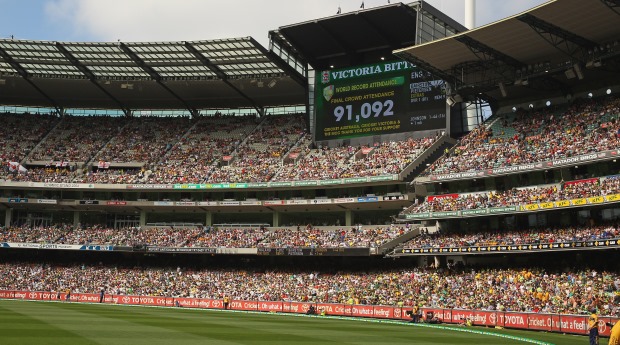
- The 2015 ICC Cricket World Cup (ICC CWC 2015) was the previous major International Circket Tournament which was jointly hosted by Australia and New Zealand during February and March 2015. This was only the second time these two nations have hosted the event, the last tournament being all the way in 1992, 23 years before the next one. The ICC CWC 2015 had the highest attendance ever officially recorded for a single day of cricket naywhere in the world (93,000) and was also the most watched cricket match in Australia, peaking at 4.2 million viewers nationally.
- The key drivers of increased economic activity associated directly with the ICC CWC 2015 include spending by local (home-state or local area), interstate and international visitors and tourists. Although it can argued that spending by local visitors at the event may have occurred irrespective of the event, this is based on the total impacts and the direct economic impacts captures the total or gross economic activity, resuled in hosting the tournament.
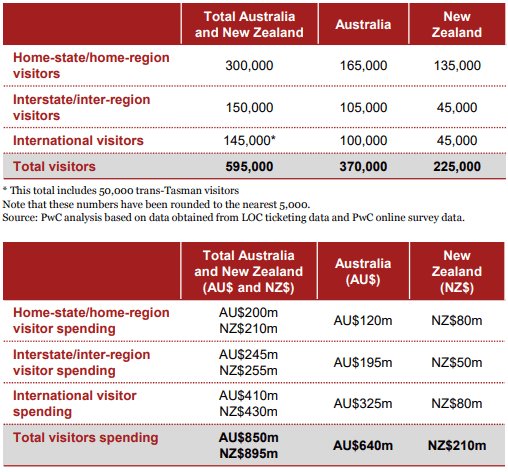
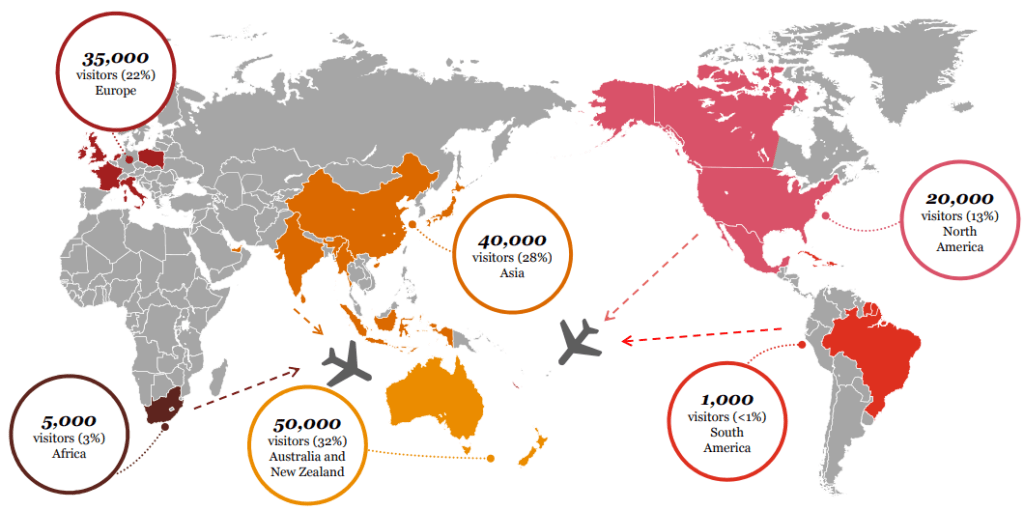
- The tournament also boosted and held many economic benefits specific tourism industries, such as hospitality and aviation. The ICC CWC 2015 attracted unique visitors from five continents outside Australia and New Zealand. This affected postively, many airlines and airports around the world, including Australia’s Qantas and the UAE’s Emirates, as they were said to be the official travel partners of the tournament.

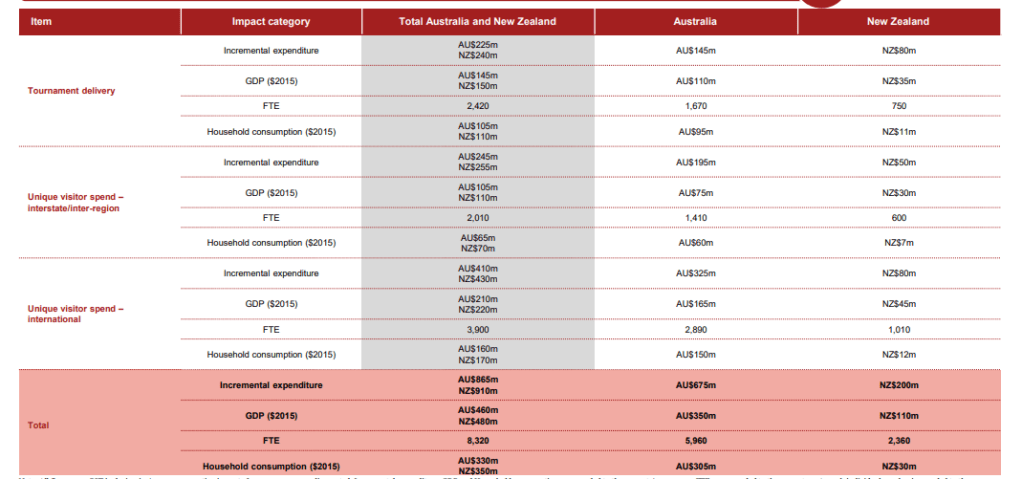
- The ICC CWC 2015, provided to Australia: AUD$350m to GDP, 5,960 full-time equivalent jobs, and AU$305m in household consumption. The effect of the tournament impacted GDP in the hospitality and transport sectors, largely in part due to visitor spending on accomodation, food and beverage, merchandise and travel. The effect of the tournament also impacted employment, because tournaent activity resulted in workforce increases through new full-time jobs, in various sectors, such as construction, retail trade, hospitality and professional serivces. The effect of the tournament impacted household consumption. With an increase in employment, consumption and key measure of econmic welfare, also rises. This is because hosuehold income increases with a higher level of employment, therefore allowing consumption to expand.
- The Big Bash League (BBL) is the Australian professional Twenty20 cricket league, which was established in 2011 by Cricket Australia, it follows a similar structure to other foreign tournaments such as India’s IPL and Pakistan’s PSL, and allows for International players to play in the league. The league is said to be the most action packed cricket games of the year for Australia and is widely popular across Australia. Although economic figures of the Big Bash aren’t released, it can be correctly predicted that these yearly domestic tournaments yield, similar downscaled figures as the 2015 Cricket World Cup, as they are vastly popular games, which attract big crowds and big online-viewing. The ticketing prices of both the BBL and WBBL are relatively cheap and family friendly, this assists in attracting crowds to these events, starting at $5 for Children and $15 for Adults in the group stage of the tournament and starting at $15 and $25 for the finals stage of the tournament. The Big Bash Final is also said to be the most viewed domestic cricketing event, broadcasted on Free-To-Air-TV. The Big Bash, similarly to the World Cup, provides alot of jobs in commerical and industrial sectors, which contributes hugely to the Australian economy.

- Cricket Australia hosts two to three international teams a year, in the form of a series. This can include a team touring and playing only a series of T20 cricket, only playing a series of only T20 and Test Cricket or playing the 5 match Test Series, throughout December and the start of January. This includes the famous boxing day test, which is held in Melbourne annually on the 26th of December (Boxing Day) against an international test team. International cricket attracts alot of fans across cities to come and support their team. This mainly attracts fans of other ethnicities, as it may be their only opportunity to watch their national side tour Australia, as alot of teams do not some that often. Broadcasting of International Games are highly watched and attract a high viewership around the world, these provide huge amounts of revenue to not only broadcasters, but to Cricket Australia, for licensing these broadcasts. Ticketing prices vary from game to game for International Series, but Cricket Australia always boasts family friendly prices, with Children tickets usually starting at $5 and $20 for Adults.
—————————————————————————————————————————————————————
ICC T20 World Cup 2020
- The Australian Government announced that it will support the ICC T20 World Cup 2020 in Australia, as part of the Budget in 2019-20. The government will coordinate support in alot of areas, this includes and is not limited to; taxation, immigration and customs for visitors and players, intellectual property, rights protection, events promotion and movement of currency. The government has stated in the document, that with more than 100,000 international fans/visitors expected to attend, Australia will reap significant economic benefits. The influx of overseas guests, will create cultural, diplomatic and community opportunties for the country, and allow for Australia to showcase as a world leader in hosting major international sporting events, which in the future can help boost Australia’s economy further, and opening more opportunities for Australia, such as hosting the Olympics later and the FIFA World Cup. The Australian Government, has set aside $7.7 million for support for the tournament, from 2019-20 and 2020-21.
- The Australian Government has decided to not construct any new stadiums or refurbrish any stadiums for the upcoming tournaments, this is as they strongly believe that the facilities around Australia, are already significant and World class that there are no need for such changes.
- However, with all of these benefits and funding, comes the opportunity cost involved with running such an event. The tournament will only bring temporary economical benefits for all industries, and although it may be a high time for them, all the money being funded in by the Government for support purposes, can be invested elsewhere for more enduring benefits and potentially more economical beneficial purposes. This can include, simply investing in the development of grassroots and local cricket, improve sporting facilities around the country or investing in another area instead, such as improve health facilities, expanding public transport or improving the quality of education around the nation.
IMPACTS ON SPECIFIC INDUSTRIES-
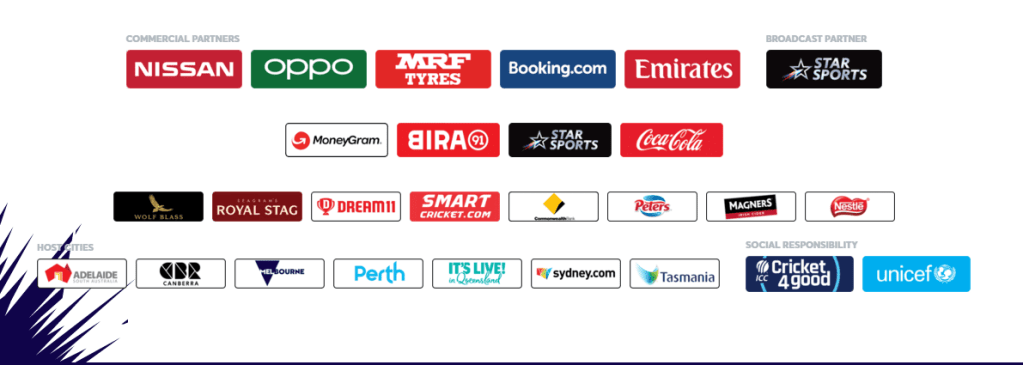
- Tourism/Travel Industry- Arguably, with the large influx on tourists and international arrivals, the tourism and travel indusrty will be one of the most positively affected as a result of this tournament. As Emirates has been named the official airline supporting the 2020 T20 World Cup, the ICC has agreed a deal with Emirates, to operate along with Qantas, to provide teams interstate travel between games. The ICC has also introduced the travel and tour packages for the tournament, which is now fully customisable. It allows for one to choose, their budget, what games they would like to attend in what cities, what places in Australia they would like to visit and explore, and using the tprovided data, would make a customized trip deal and provide discounts to consumers, due to their affiliation with Emirates (flight discounts) and Booking.com (Tours and Accomodation discounts). This not only affects their partners, but also the hotels and tourist attractions, as they would most likely recieve more bookings around this time.
- Hospitality Industry- The Hospitality Industry and the Tourism/Travel Industry tie in together. The Hospitality side of the event, would include services such as hotels, recreation and food and transportation. Hotels all around the host cities would benefit, as previously mentioned, the ICC offers discounted booking through their partner Booking.com, which allow access to a range of high quality hotels. The hotels would also benefit, as the ICC would buy full suites or full floor of a hotel, to provide accomodation to teams and officials. In terms of food, the fast food industry will be buzzing during this period, as in stadiums there are some joints available, such as KFC or Pizza Hut at the MCG, there would be regular games, bringing more customers to the joint, making the joint more profit, and circulation in the economy, from the supplier to the consumer. Coca-Cola is also an official partner of the tournmanent, and provides beverages around the ground to spectators and mainly teams for hydration, the advertisement will benefit both the tournament, and the brand for its beverages. But argueably, the most impacted part of the hospitality industry, is the transportation system. Services such as Uber, will have a huge boost, as people will seek transportation to the venue or back to their home/hotel. Taxi will also be a huge service being used for similar reasons, as well as the Tram and Train sectors, as they provide easy transport for supporters and tourists.
- Media Industry- The Media Industry will also heavily effected by this tournament. The tournament is bound to gain attention from the press, from major sporting news services such as ESPN (cricinfo), Sky Sports and BBC Sport, this will benefit both parties and also provide coverage worldwide. Cricket Australia has provided official broadcasting partner rights to STAR SPORTS, who are allowed to provide other TV Stations with broadcasting rights for the events. This will enable for the games to be broadcasted to over 200 countries. The current trend, is streaming, for example, Netflix, Stan and Disney+ are all streaming services for movies and TV shows and recently, some sport streaming services have been introduced, such as Optus Sport and Kayo. Kayo owns exclusive mobile streaming rights to the 2020 T20 World Cup, for both womens and mens tournaments, but, the Kayo Streaming service is only available in Australia, and options outside of Austarlia, are extremely limited, or illegal. This will be the perfect opportunity for Kayo to expand into the Global Market, and offer a sports streaming service in other countries. Not only will this attract more users to sign up and subscribe to Kayo, it will also economically impact them and allow their business to expand more.
—————————————————————————————————————————————————————
Why the 2020 T20 World Cup will be more successful than the 2015 World Cup
- The 2020 T20 World Cup, will be more successful than the 2015 World Cup purely because it is bound to attract people and brands. The shortest format of the International Game is the 20 over, T20 format, and it is action packed! There is more action in terms of cricket, with alot more explosive hitting and not a boring slow-paced game, like an ODI can be at the start or like a Test match can be. This shorter format, attracts families to come, as it is short and families do not enjoy being dragged the whole day and being bored. Another first, which is sure to attract more to this years tournaments, are double header matches. For one ticket, you can watch two matches in one day, back to back. Ticketing prices are also similar to the CWC in 2015, starting at $5 for Children but the ticket prices are now starting at $35 for Adults, instead of $20 from the CWC in 2015.
- Below, again, are the economical figures produced from the World Cup in 2015. It can be predicted that this years 2020 tournament will provide similar results, but be more successful at the same time. See, as their are less teams and less games in the tournament, ticket revenue will not be as high, but as the merchandise, tourism and other visitor spending will be higher than usual, it will allow for somewhat similar Total Direct expenditure results to be produced and have a similar impact on Australia’s GDP, Jobs created and household consumption.
Some questions that I have after researching the economical impact of hosting major sporting events, and the potential benefits the Australian economy will recieve after the upcoming ICC World T20 Cup 2020, are as followed;
- How will the government use the money and expenditure gained from hosting the tournament?
- What areas would the government have put the $7.7 million into, if it wasn’t for funding this tournament?
- How will other, non-hosting nations, benefit economically from this?
- If the tournament is as successful as the previous tournament in 2015, will this help build Australia’s legacy and if so will it assist them in hosting major global events, such as the Olympics or the FIFA World Cup?
- How does the economy react, after the tournament is over?
—————————————————————————————————————————————————————
References-
Official Cricket Australia, 2015 Cricket World Cup, Economic impact and benefits analysis
Download
WEBSITES–
The Economic Impact of Major Sporting Events – https://bit.ly/39XImW5
Is there any real economic benefit to hosting a World Cup- https://bit.ly/32i6bVW
FIFA World Cup 2018 Economic Report- https://bit.ly/37R1G5G
The Economics of the FIFA World Cup 2018- https://bit.ly/38Sa1HU
The Advantages and Disadvantages of hosting a major sporting event- https://bit.ly/2vWyBbU
Cricket Australia- Annual Reports- https://www.cricketaustralia.com.au/about/annual-report
ICC Cricket World Cup 2015 gives economic boost– https://www.icc-cricket.com/news/181588
ICC T20 World Cup Australia 2020- https://www.t20worldcup.com/
ICC TRAVEL– https://www.icctravelandtours.com/
ICC Hospitality- https://t20worldcuphospitality.com/

 Year 11 MHS Economics 2020
Very well done. Good formatting. You cover a broad range of issues in great detail. I like how it weighs up the advantageous and disadvantageous effects on the economy from events like this.
LikeLike