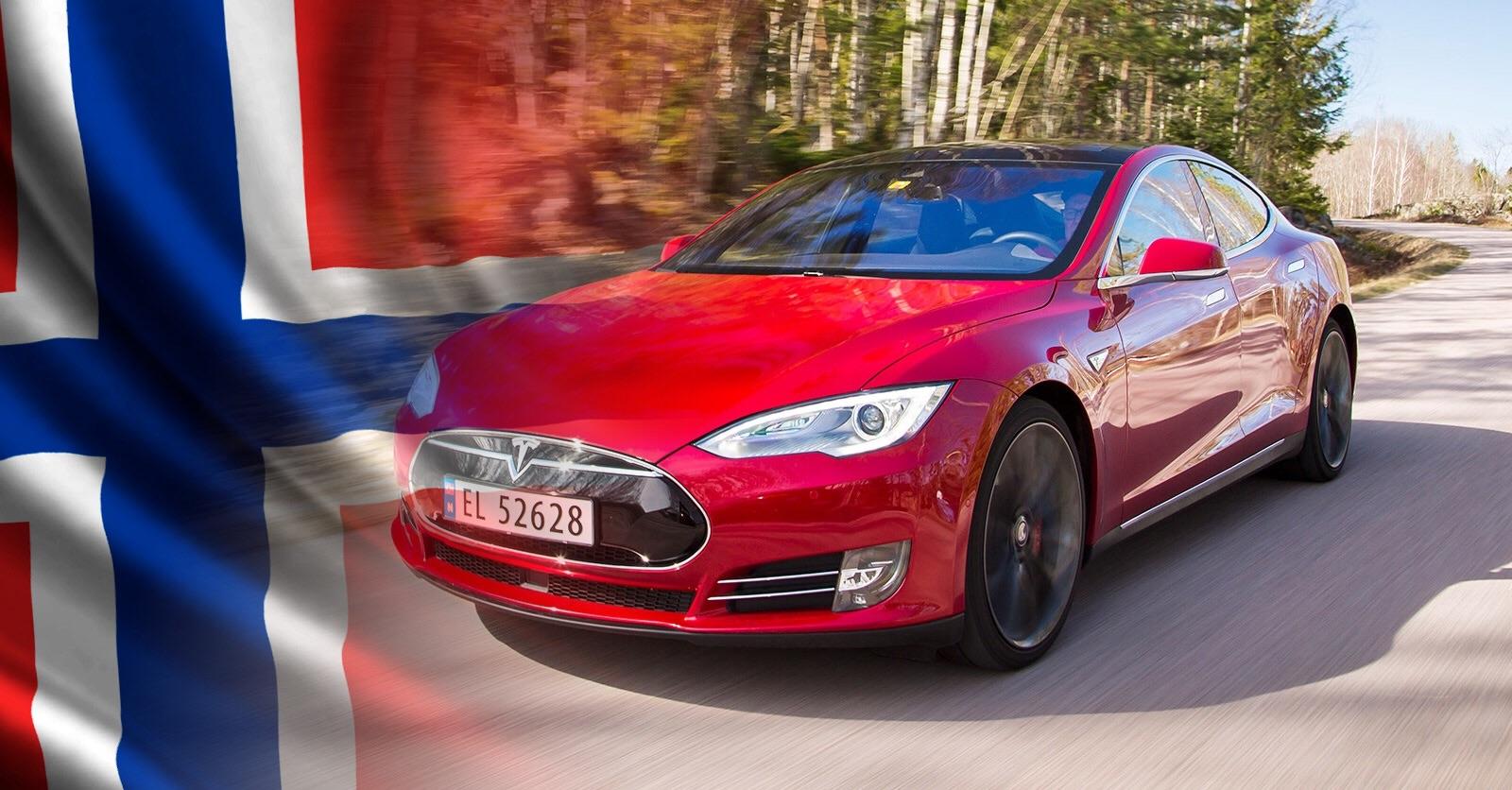
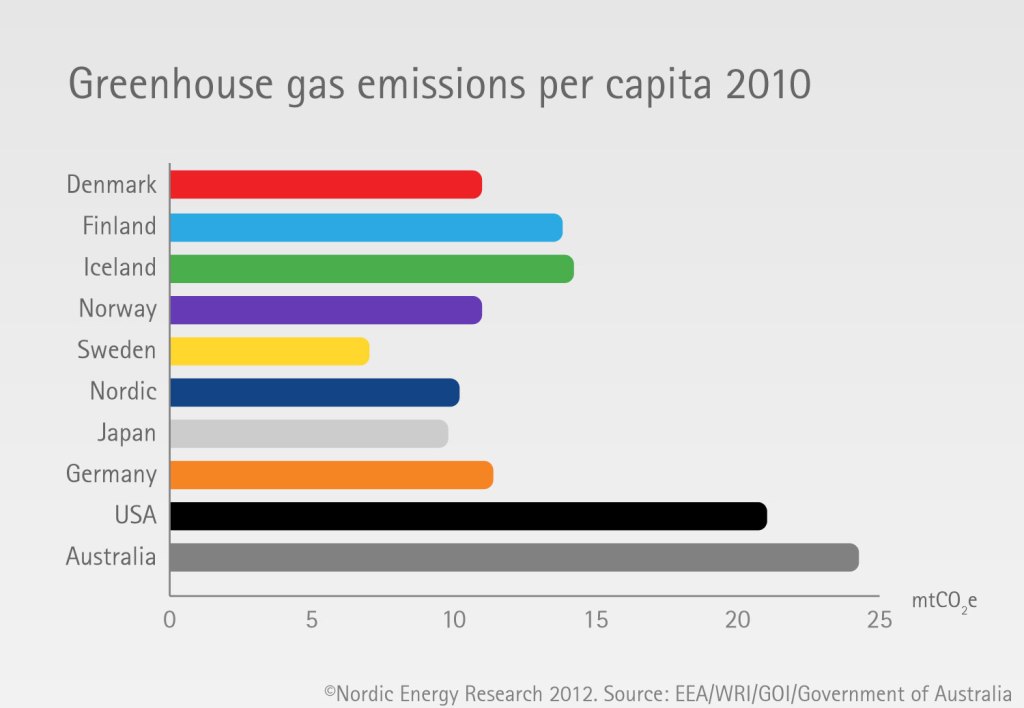
A sparsely populated country in the Scandinavian region has been creating a large economic footprint in the recent decade. Norway ranks 66th in the world in carbon emissions (per million metric tonnes), ranks third for highest GDP per capita, and is the most liveable country in the world with a United Nations Human Development Index score of 0.954.
Is Norway as Good as it Seems?
Material living standards are a measure of a countries access to tangible goods and services and is usually measured by the GDP. However, many economists argue that GDP only provides a wholistic picture of a nation and excludes important factors that contribute to human well being. For example, China’s GDP is twelve times greater than Australia’s, however people may prefer to live in Australia because of factors like freedom of speech and voting rights.
It is clear by the statistics above that Norway has favourable material living standards. However, what is often overlooked is Norway’s distinguished methods and practices that helps create such prominent economic figures. In this blog, we will focus on how Norway’s Electric Vehicle (EV) market is significantly driving their economic performance.
The Demand for EV’s
Like Australia, Norway is a mixed market capitalist economy. In a capitalist society, the production and sales of toothbrushes, watches, and of course EVs are dictated by what the consumer wants. Norway leads the world in the EV market share, which is the portion of the market controlled by the sector. Simply, the Norwegians just want to buy Teslas!
Additionally, government incentivisation – a common feature of mixed markets – is another factor influencing EV growth. Government incentives are financial benefits organised by the government to encourage citizens to do something in particular. In Australia, government incentives include paid parental leave and the “Baby Bonus” introduced in 2002.
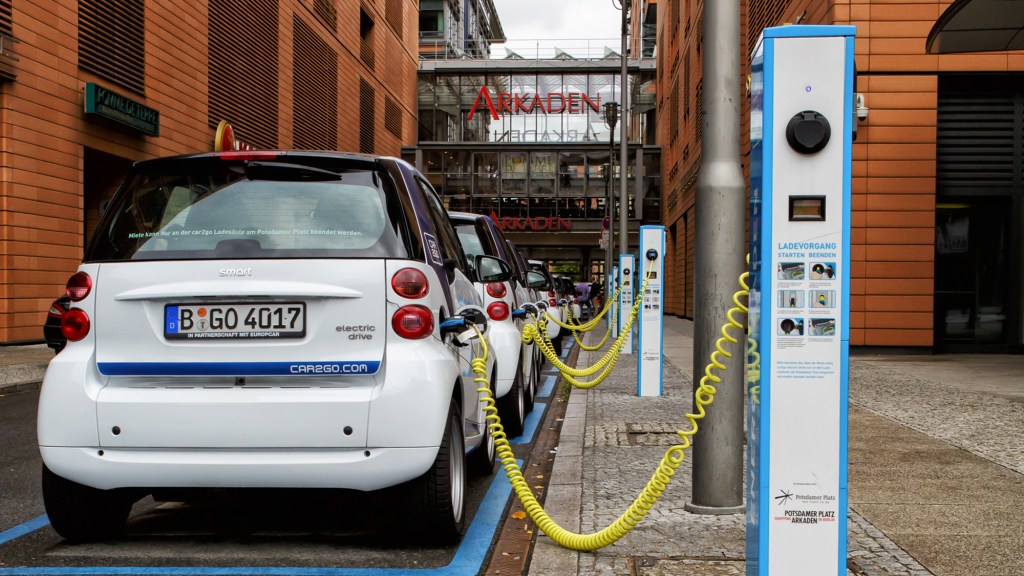
Currently in Norway, there are a multitude of benefits for simply owning an EV. A few significant benefits include no purchase taxes, no toll charges, no annual road tax, free municipal parking, and access to free charging stations around the city.
The incentives have been working too. According to the Norwegian Information Council for Road Traffic, Norway’s overall average carbon emissions per vehicle is 69gm/km, down 10gm/km since May 2018. While at the same time, the entire market share for electric cars in Norway reached 35%, up from 22.3% from May 2018.
The Horsepower of EV Incentives
In Norway, the mixed market capitalist economy is working exactly as designed. The introduction of EV government incentives coincides with the increasing consumer want for the latest automatic-driving technologies to promote Norway’s EV market share to the largest in the world. The increased imports and purchasing of EVs have helped boost the country’s economic indicators like the GDP to third in the world while simultaneously lowering carbon emissions, advancing driving amenities, and improving air quality for citizens.
Unlike other economic powerhouses, Norway does not neglect its citizens in terms of non-material living standards. The benchmark should be for more countries to adopt consumer-centred economic practices like Norway given the successful outcomes of their economy.
Author: Justin Leung
References
Elbil.no. (2020). Norwegian EV policy. [online] Available at: https://elbil.no/english/norwegian-ev-policy/ [Accessed 19 Feb. 2020].
Expert, G. and Expert, G. (2020). Baby bonus responsible for high birth rate in Australia? | .id blog. [online] .id blog. Available at: https://blog.id.com.au/2011/population/demographic-trends/is-the-baby-bonus-responsible-for-the-high-birth-rate-in-australia/ [Accessed 19 Feb. 2020].
InfoPlease. (2020). Most Livable Countries. [online] Available at: https://www.infoplease.com/world/political-statistics/most-livable-countries [Accessed 19 Feb. 2020].
Pressman, M. and Pressman, M. (2020). This Is How Tesla & Electric Cars Conquered Norway | CleanTechnica. [online] CleanTechnica. Available at: https://cleantechnica.com/2019/10/10/tesla-electric-cars-conquered-norway/ [Accessed 19 Feb. 2020].
Investopedia. (2020). Everything You Need to Know About Market Share. [online] Available at: https://www.investopedia.com/terms/m/marketshare.asp [Accessed 19 Feb. 2020].
Schmidt, B. (2020). Boom in Model 3 sales pushes Norway Tesla numbers to 40,000 | The Driven. [online] The Driven. Available at: https://thedriven.io/2019/06/11/boom-in-model-3-sales-pushes-teslas-in-norway-to-40000/ [Accessed 19 Feb. 2020].
Study.com. (2020). Material & Non-material Living Standards – Video & Lesson Transcript | Study.com. [online] Available at: https://study.com/academy/lesson/material-non-material-living-standards.html [Accessed 19 Feb. 2020].

 Year 11 MHS Economics 2020
This is some very interesting work, Justin. I like the idea of introducing the article with an economic concept.
LikeLike
Good read Justin, the perks of owning an electric car in Norway are interesting.
LikeLike
The title is really interesting and so is the article Justin. Would be better if the article states how EV cars reduce carbon emissions.
LikeLike
Great article, Justin. The incentives seem to really aid in convincing more people to use electric vehicles.
LikeLike