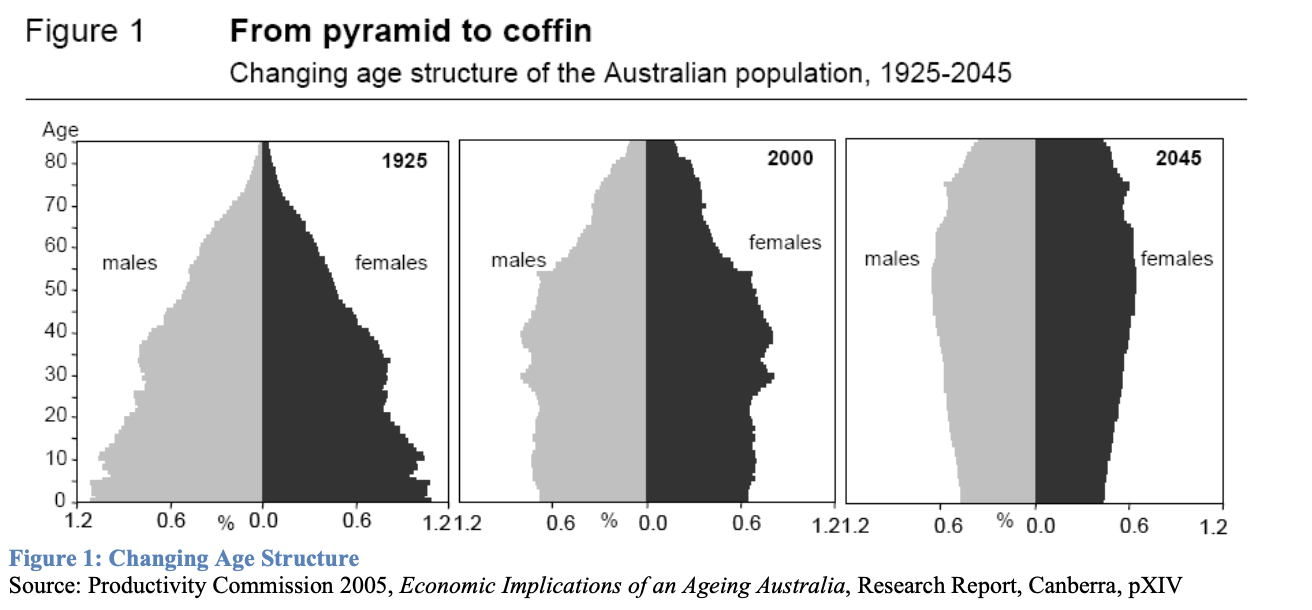
Australians have a very luxurious and privileged lifestyle as one of the countries with the highest GDP PC; we have well built out infrastructure, good healthcare and a very high life expectancy. Unfortunately for us though a side effect of this high standard of living is that we tend to have fewer children. And that means a larger and larger proportion of Australians that are getting too old to work and those who are working are getting older. The median age for Australia is 38 years old, meaning half the population is 38 or older. See the population pyramids below.
This can have devastating consequences on the economy if not properly managed. By definition an ageing population means a shrinking workforce because there are less people to work as more people retire as they grow old. In economics we have 4 main resources, Land, Labour, Capital and enterprise. In this situation the one that would be most affected would be Labour. As less labour is available the price of the labour itself will be driven up. This cost will not only be passed on to the consumer to maintain profit but overall fewer goods and services will be able to be produced. We can visualise this further in a production possibilities curve which shows the maximum amount of goods or services that could be made with a given finite amount of resources.
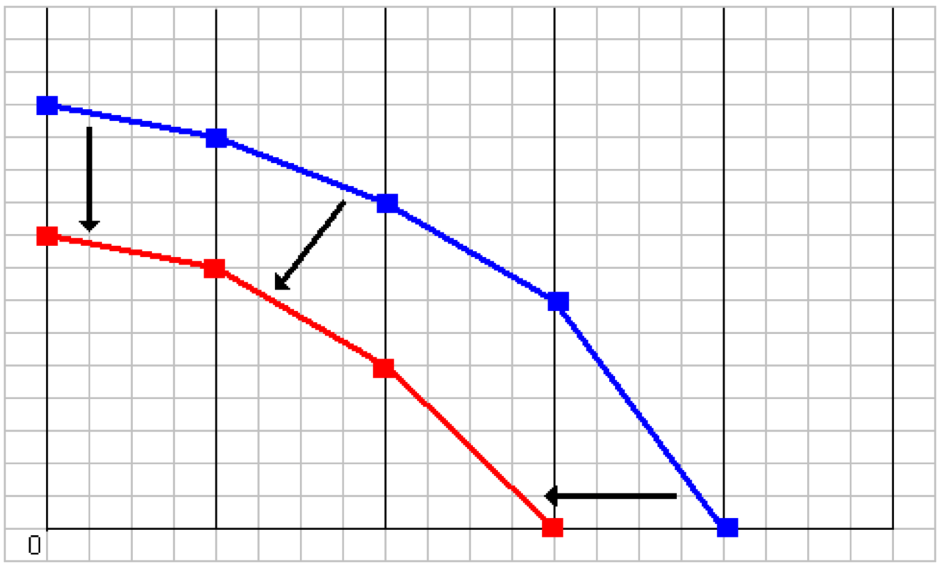
The curve shifts inwards as less goods can be made due to the lower availability of labour. We also need to take into account that there are more people to support such as people that have retired and not contributing to the economy. Meaning that each worker has to provide for themselves but also a growing number of retired people. Japan is a prime example of this with the one of the oldest populations in the world accompanied with a critically low birth rate. Japan suffers from chronic deflation and economic stagnation because of this phenomenon.
Japan’s (and Australia’s) economy is a car whose engine (workforce) keeps losing horsepower but the weight (retired population) of the car as a whole keeps increasing. Ultimately the effect of this is that as goods and services become more expensive, it will become less affordable for the entire population to satisfy our unlimited needs and wants with our shrinking (labour) finite resources; this will reduce economic growth. This means for the average worker it will be more difficult to retire at 65 and taxes will continue to increase in order to support the pensioning population and to be completely frank that’s what’s required of the population to get through this.
Oddly what I believe is most likely to provide the most relief from this impending crisis is social reform rather than economic. The government needs to make it more attractive for young couples to have children, increase the barriers to retirement and start saving for when the bills from the disproportionately large pensioning population start rolling in. This means government intervention in our market economy by passing legislation to subsidise homes along with childcare, reducing loopholes in welfare that allow workers to retire early and even raising the minimum retirement age and put aside a fund for pensions and healthcare for after 2040. All of these things will reduce the economic strain on Australia.
Bibliogaphy
Cheng, A. (2007). https://www.rba.gov.au/education/talks-and-events/economics-competition/2007/pdf/first-year.pdf. [online] Rba.gov.au. Available at: https://www.rba.gov.au/education/talks-and-events/economics-competition/2007/pdf/first-year.pdf [Accessed 18 Feb. 2020].
Pettinger, T. (2020). The impact of an ageing population on the economy – Economics Help. [online] Economics Help. Available at: https://www.economicshelp.org/blog/8950/society/impact-ageing-population-economy/ [Accessed 19 Feb. 2020].
Franklin, B. (2020). What are the economic implications of ageing populations?. [online] World Economic Forum. Available at: https://www.weforum.org/agenda/2015/10/what-are-the-economic-implications-of-ageing-populations/ [Accessed 18 Feb. 2020].

 Year 11 MHS Economics 2020