

From the depths of absolute poverty in the 1960s to now as one of the wealthiest nations in the world, it is apparent that China’s emergence as a global superpower is an unprecedented achievement in economic growth. From economic to political maneuvers the reason for such growth can be explained through a multitude of different reasons, in this article it will become apparent that China’s economic reform, starting in the 1970s, was in large part due to two factors:
- China’s deviation from its collectivist policies, and gradual reform to a market-based system.
- China’s ability to capitalise on its demographic dividend.
People’s Republic of China Pre-reform:
Before illustrating the improvement of China’s economy, it is imperative to understand the system it was reforming from. In 1958 Chairman Mao had begun his ‘Great Leap Forward’, aiming to boost agriculture and achieve rapid industrialisation. However due to the mismanagement of grain distribution, a communal dining system which allowed the people to eat for free- and therefore not surprisingly- lead to overconsumption. As well as an inflated estimate of its yearly produce, Mao had created the worst famine the world has ever seen with a death toll estimates in the tens of millions.
Yet only a few years after China was again embroiled under disaster, Mao who slowly was losing power due to his calamitous policies, instigated social upheaval by eliminating all those who he believed were a part of the bourgeois or the capitalist intelligentsia. Millions were killed by the purge as another terror swept through communist China. With such a turn in society, the country again faced economic turmoil with professionals such as doctors who were executed due to their liberal thinking, as well as scientists working on improving the country’s future technological potential were sent to toil on farms. In 1976, Chairman Mao passed away due to a heart attack, finally allowing changes in a system of terror. Such circumstances make the transformation of China even more monumental and confounding.
Evidence of Economic Growth:
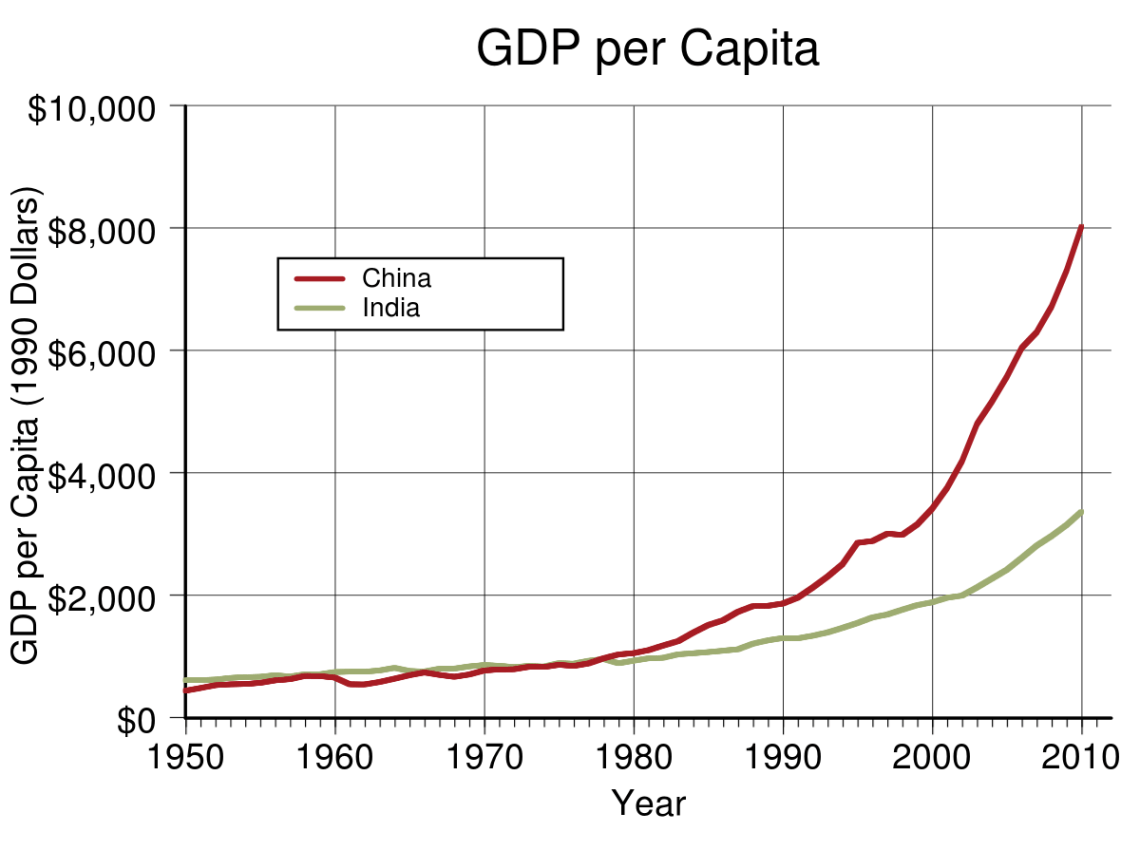
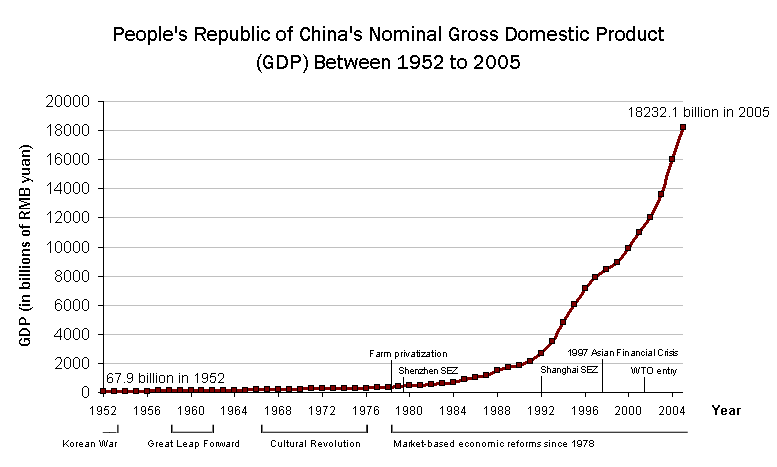
Factor 1 of China’s Economic Growth: A turn towards a market economy; Post 1978
Firstly, China’s abandonment of socialist ideas and a turn towards a market-based economy, allowing private business and international trade created expansive economic benefits. China’s gradual deregulation of small businesses had created greater efficiency within their respective sectors. Small businesses aiming to achieve profit were far more efficient with their ability to provide the needs of the consumer than state-owned enterprises, due to their reliance on the government. As businesses were more inclined to provide what the public demanded they allocated their resources in a way that reflected the society’s needs, reducing unwanted goods.
In addition, the deregulation of the rules regarding small businesses’ hiring ability, allowed millions of unemployed workers in rural areas to find work in the cities. In fact, the service industry had more than doubled from 48.7 million to 99.5 million in ten years. This surge in the workforce allowed more small restaurants and labour contracting services to operate furthering the economic output of the country. With this increase of labour came also government incentives for businesses that were performing well, for example, bonuses were given to individuals who were believed to work the most effectively. Additionally, although larger enterprises such as factories were still state-controlled, the government allowed a few to retain a certain percentage-usually 30%- of profit in order to boost productivity. Similar tactics were slowly implemented in an array of companies due to an increase in production that the plan saw. Such policies to increase productivity and individual economic success were forcibly prohibited by China under Mao.
Furthermore, an opening of borders leading to trade and investment had dramatic effects on the nation’s economy. The aforementioned increases to production that had boosted the economy led to an increase of outputs that could be exported or sold to other countries. Foreign investors observing such an economic revolution also sought to invest in the nation, providing new technology and capital in order to improve China’s ability to efficiently produce goods. China’s need for energy and natural resources such as oil can also finally be met when opened to the international market, materials necessary in order to support its booming infrastructure sector.
Moreover, China’s ability to export goods has allowed increased profits through the reformation period. For example, in a span of 22 years from 1979 to 2001 China’s total exports had increased 20-fold from 13.7 billion to 266.2 billion dollars. China’s low-cost workforce allows its products to be extremely competitive in the market when even today we can notice most of our clothes and manufacturing are made in China. China’s free trade agreements with other countries allow competition to enter its own market with foreign goods able to compete with their domestic goods, and conversely, its own goods were able to compete with others in an international market. Such means allows prices to decrease with both international and domestic goods, enhancing the accessibility to goods by consumers. An allowance of foreign impact and investment as well as a market system in general although prohibited 20 years before, became instrumental in the development of China’s economy.
Factor 2 of China’s Economic Growth: China’s Demographic Dividend
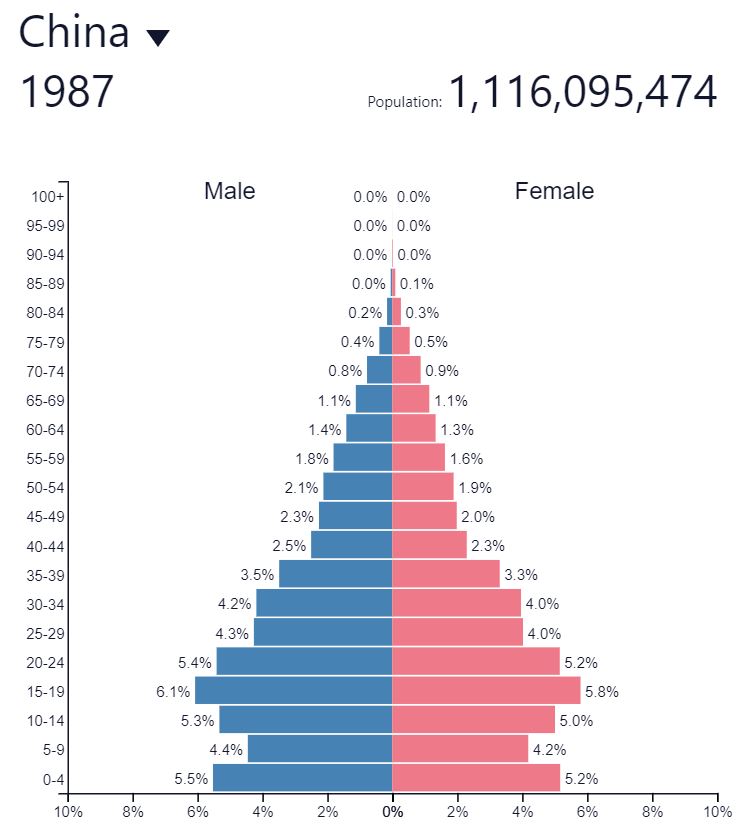
Secondly, in the time of reform, China had an extraordinarily high number of working-age citizens, but more importantly, and extremely low dependency ratio- the ratio of dependents to working-age people. This can be illustrated through the population pyramid below, where approximately 70% of the population is in the working-age (15-64), this increase of working-age citizens is known as a demographic dividend. A concept that can streamline a country’s growth, especially one attempting to climb its way back up. A country with unlimited labour is able to undergo policy changes and saturate different industries, it is able to farm, manufacture goods and most importantly innovate new technology, which will more effectively produce outputs. Additionally, companies are more likely to succeed and relocate to a society that is filled with a large working population. A population with a large working force must compete in order to find an occupation, in these situations workers are more likely to take lower wages and standards of living. With this consequence of a large working-age population, businesses are able to take higher profits which allows them to further invest in their facilities. Facilities where companies know there will always be a supply of labour able to make it function. A combination of the demographic dividend as well as the development of policies allowing citizens to choose their occupation, dramatically improved the standards of living of the individual, who can now take a job, and that of the business who sees a higher profit.
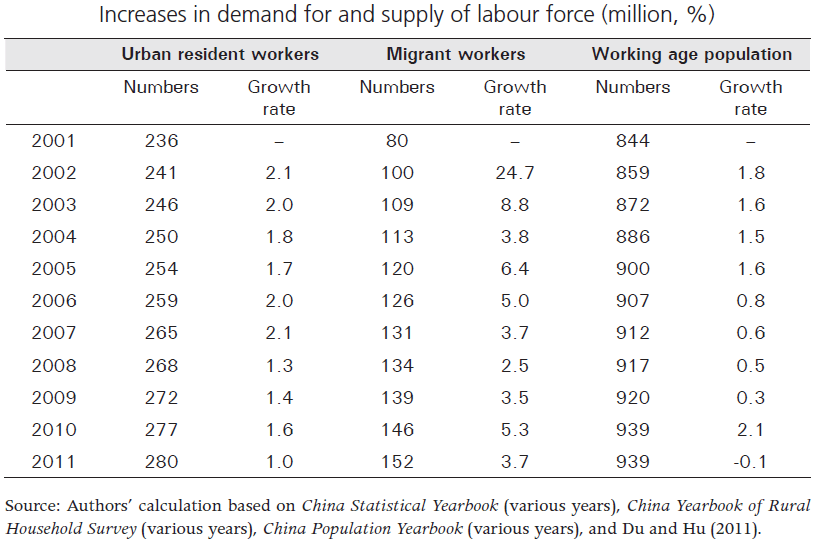
On the other hand, although the demographic dividend brings rapid economic growth, it is often considered a double-edged sword. China’s economic growth that is predicated upon a large working-age population is unsustainable, as for those who were the locomotive of change in the 1980s are now elderly men. This in combination with the fact that China’s birth rates have plummeted leaves itself now with an aging population. Due to birth control policies, most notably the One Child Policy, the working-age population is ever depleting, with a decreasing number of young adults the dependency ratio will only increase. This can be observed through the chart below detailing the decreasing growth rate of the working population, while an influx of migrant workers is filing into the country- an idea unfathomable 30 years ago. An essential part of the workforce given the decay of the working population. Such a decrease will only lower productivity, with those who are apart of the working population must now care for relatives who need constant supervision and care. In addition, all of the benefits that have been taken for granted would disappear, businesses will eventually have leftover capital without the labour necessary to use the available technology and China’s labour will be unable to fulfill pivotal positions in factories and industry. Policy advisors and researchers insist that China focus on improving its technology and production facilities in order to compensate for the decreasing working population.
Conclusion:
China’s masterpiece through the 1980s to the present was largely due to an ability to reform regulation, an embrace of the global market, while at the same time reaping the rewards of its demographic dividend. Yet, China today faces numerous problems regarding its environment and its public health, not to mention the ongoing trade war with America. China although victorious once before must finally live up to its name as a global superpower and find a way out of its current economic downturn.
References:
https://apps.dtic.mil/dtic/tr/fulltext/u2/a511980.pdf
https://pdfs.semanticscholar.org/1397/632f483a5821c3116fb2dbd88cc439cb68cc.pdf
https://pdfs.semanticscholar.org/b330/9dc31b097e1e7ec8990427fefb68f065fb77.pdf
https://www.populationpyramid.net/china/1987
http://citeseerx.ist.psu.edu/viewdoc/download?doi=10.1.1.463.8923&rep=rep1&type=pdf
https://pubs.aeaweb.org/doi/pdf/10.1257/jep.8.2.23
China: a new model for growth and development / edited by Ross Garnaut,
Cai Fang and Ligang Song.

 Year 11 MHS Economics 2020
Great level of detail and insight – very good to compare to India’s example.
LikeLike
Nice Digital China Flag Feature Image. Everything Else Is Amazing. Good Content.
LikeLike
Excellent Economic analysis of how the evolution of China’s political decisions affected the world superpower that exists today. Great graphs, concise yet dense writing and an almost expert understanding of socio-political factors at play in a complex society like China. The greatest skill of this piece lies in its ability to tackle the great challenge of this task, distilling incredibly complex and in-depth research and understanding of a truly immense issue into a digestible format that appeals to the layperson as well as the expert. Excellent job!
LikeLiked by 1 person
Simply amazing! Loved the thoughts and opinions! Write on Will!
LikeLiked by 1 person