
With the recent news of the United Kingdom to accelerate its vision for the banning of buying and selling of petrol, dieseled and hybrid power vehicles (including all modes of land transport) by 2030, it begs the ultimate question of, “What the future market will hold for the UK automobile industry?” and in relation to us, the ramifications this will have an impact to the Australian community as a result.
How feasible is the target?
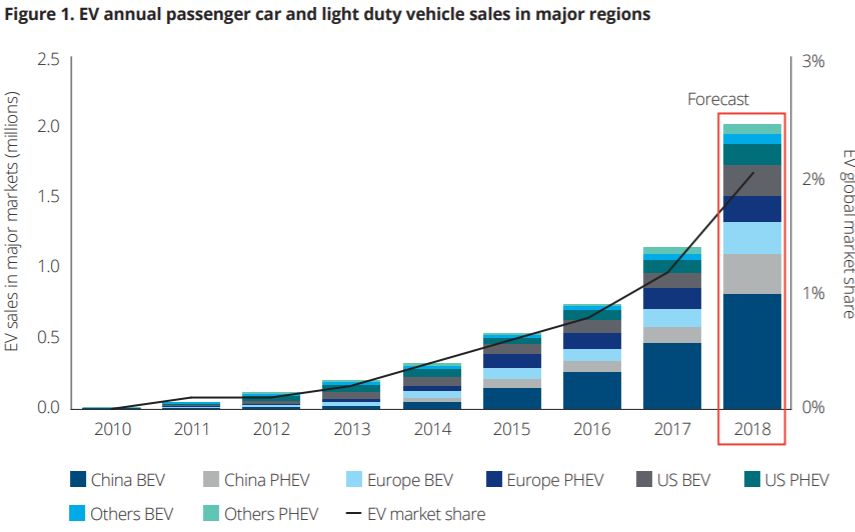
According to the BBC, the committee of government advisers assumes that by the mid 2020’s a parity or an equilibrium point would be reached between electric, petrol and dieseled cars. This also has been complemented by the significant growth in the electric vehicle market throughout the last decade prompting the move for this objective to be brought forward. However, this would come at a significant capital cost (but a more sustainable outcome in the long run) with the expenditure to adopt for the availability of charging stations to increase exponentially in conjunction with their deadline, as demonstrated in 2017, the UK government spent a total of 14.7 billion pounds equating to ($28.54 billion) on environmental protection.
This growth in the market is also complemented by the UK’s implemented subsidies of 3500 pounds ($6795.65 AUD) which is another variable to increase interest in the consumer market to consider the viability of these automobiles. Although this is the current case, it is important to note that Government subsidies have dramatically declined since its induction in 2009 where this has been occurring in line with the increase demand in the market. The rule of thumb in business is to find the equilibrium point between the supply and demand where one factor does not exceed the other and intersects. In this case, the demand is exceeding the supply which is why the Government has had to strip 25% of its subsidies to compensate for the facilitation for the mass adaptation of electric cars (charging stations) that is needed to increase customer utility.
How would this affect future vehicle markets?
I really do encourage other manufacturers to bring electric cars to market. It’s a good thing, and they need to bring it to market and keep iterating and improving and make better and better electric cars, and that’s what going to result in humanity achieving a sustainable transport future. I wish it was growing faster than it is.
Elon Musk
The automobile industry has already begun to transfer its resources into the adaptive vehicle market of the future in conjunction with Governments like the United Kingdom whom are accelerating their vision for the termination of petrol and diesel powered cars. With the arrival of niche motoring companies such as Tesla (whom have encouraged for other car manufacturers into the market), major automobile firms need to adapt to the rapidly shifting industry, otherwise risk the perpetuity of the business. A key example of this is Holden whom late last month has announced a complete shutdown of first-hand sales in Australia due to declining cash flow which has resulted from their inability to adapt with the changing market. Therefore, it can be determined that through this innovation in the motoring industry, there will be emerging and revolutionary car manufacturers in the future but this will be negatively compensated with the demise of some of the current giants in the car industry.
Why is Australia significantly slower to adapt to change?

In relation to the eradication of the buying and selling of petrol, diesel and hybrid vehicles powered vehicles, Australia’s aspiration for carbon neutrality (the achievement of net zero carbon emissions) is to be met at 2050, in correlation with the mandatory ownership of a renewable vehicle if needed. Being the 6th largest economy in the world (compared to Australia at 14th), the United Kingdom has the ability to allocate a larger amount of its resources for the integration of electric vehicles into society. This has also been complemented by its geographical landscape (which is smaller in land size and more urbanised than Australia) which is another key reason why Australia’s development has been drastically slower then other developed nations.
But, what can Australia learn and gain from the governing body of the United Kingdom to accelerate its objective?
- The improvement in its efficiency for the passing of laws to the higher levels of parliament (delayering the structure in the government), therefore increasing the rate that new rules and regulations are passed into society
- Introduction of new policies (subsidies and incentives) to drive up the demand for electric vehicles
- Invest a larger portion of annual spending to more efficiently and productively build a larger infrastructure to help support and promote the usage of electric vehicles.
Personal verdict
Ever since I was a child, I was always a major fan into the development of vehicles and the vast transformation that has occurred during the technological age. As a “car enthusiast” and a current learner permit driver on the roads, I feel that it is my obligation to spread the word, that it is time that we need a more productive, objective and efficient parliamentary system, and we should not tolerate their failings as it will “come back to bite us in the future.” No matter whether we “6.8 Litre fully-aspirated knuckleheads” like it or not, our world is on the brink of collapse, with resources being converted into goods and services as my keys continue to click away. With the availability of electric vehicles in the market, this raises some fundamental questions into the ethics and politics in society: – – Is the government not doing enough to encourage the development of renewable vehicles? – – Are we on the verge of our self-destruction? – Am I a contributor or driving factor to the atrocities that our happening in our world? Whether the future of renewable automobiles is in electricity or not, only time will tell…
Bibliography
- All Electric Vehicles Latest News. (2020). The Australian Government Incentives for Buying Electric Vehicles?. [online] Available at: https://www.allelectricvehicles.com.au/blog/are-there-any-australian-tax-rebates-for-buying-electric-vehicles/ [Accessed 5 Mar. 2020].
- Phys.org. (2020). How Australia can be a carbon-neutral nation by 2050. [online] Available at: https://phys.org/news/2019-03-australia-carbon-neutral-nation.html [Accessed 5 Mar. 2020].
- BuyaCar. (2020). Government electric car grant: the complete guide. [online] Available at: https://www.buyacar.co.uk/cars/economical-cars/low-emission-cars/536/government-electric-car-grant-the-complete-guide [Accessed 5 Mar. 2020].

 Year 11 MHS Economics 2020