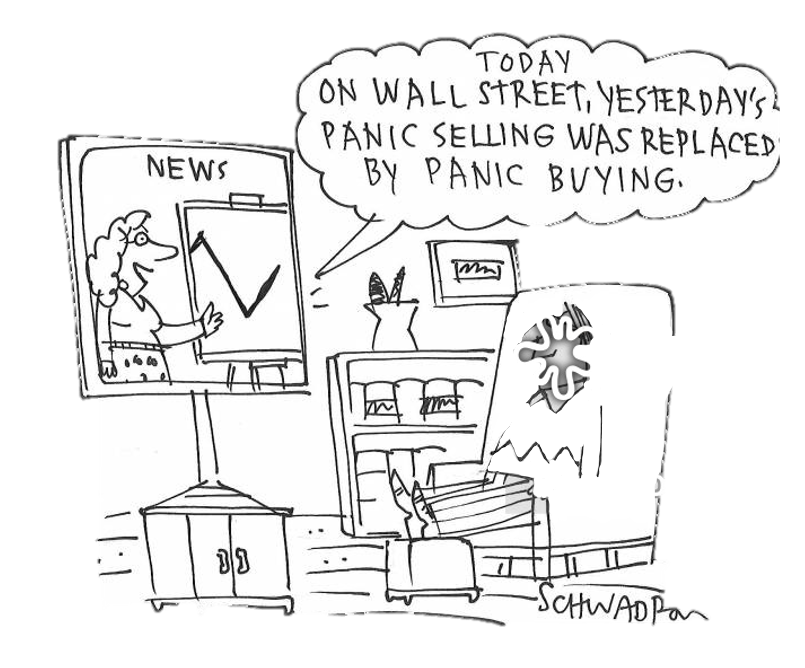
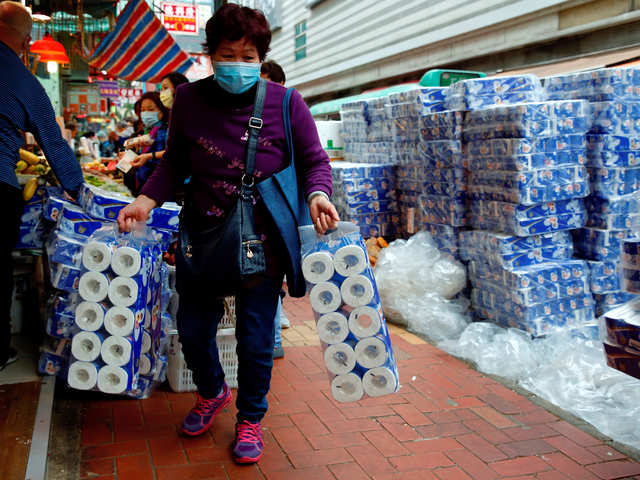
Shoppers in Australia, Japan, Hong Kong and the United States have been caught up in the panic-buying of toilet paper whilst Indonesia have experienced a spike in herbal medicine consumption, due to the ongoing Covid-19 pandemic. Shop shelves are being emptied as quickly as they can be stocked.
So, what does this mean for the economy?
Panic buying is a type of herd behaviour and is a result of the fear of missing out (FOMO), which is a consumer behaviour similar to run on banks, where everyone tries withdrawing cash simultaneously due to a pending economic collapse. This is impossible due to fractional reserve banking (where banks only hold a certain percentage of their assets in cash, the rest is not ‘physically’ available). This concept can be applied to any number of resources due to relative scarcity, given that only so much of something can be produced.
So, the toilet paper market can be thought of as a coordination game where there are two players: you and everyone else. The results can be either successful coordination (where no-one panic buys) or coordination failure (where everyone panic buys). Both of these reach an equilibrium, as consumers are mimicking each other, however coordination failure is the undesirable equilibrium.
But why?
Because it is not sustainable nor rational (discussed further under ‘Behavioural Economics’ heading) to buy several packs of toilet paper, and is ultimately producing more harm than good for the economy. Coordination failure might simply mean the production of more toilet paper on the surface, however it has a domino effect with respects to the rest of the economy, and can harm shareholders of particular businesses (in this case businesses not selling essentials/staples, e.g. seafood, meats, etc), including employees, who may be stood aside and thus not receive their salary to contribute back to the economy. For companies experiencing the panic-buying of their products, it places great stress on supply chains, however it is most likely beneficial for employees in retaining their job and shareholders witnessing greater demand and sales in products. International stakeholders who own multinational brands would experience mixed-feelings. Panic-buying of products like toilet paper is generating revenue from a business perspective, however a production halt in China could be ultimately lowering the number of manufactured products, costing the stakeholders in the long-term.
Scott Morrison’s recent address specifically urged companies to not lay off workers, ‘hold on to their people’ both full-time and casual, in the wake of uncertainty. This is fueled by the decrease in trade and the susceptibility of workers becoming sick. This is especially difficult for small businesses, who require monetary support by the government, without having the cash on hand to pay for sick leave. Other affected stakeholders include consumers who purchase certain products (e.g. shortage of toilet paper would affect all consumers) and the shareholders of specific companies, like Qantas, experiencing weaker performance and less profit, due to the lack of consumer confidence in travelling and government intervention in the form of smacks, by placing bans on travel to certain countries.
There are two steps to prevent coordination failure. One solution is price gouging, which involves increasing the price as demand increases, but this is an unlikely solution due to social outburst (you can’t reasonably sell a pack of toilet paper for $20). Another solution is the government to act as a guarantor and hold a strategic stockpile. Or the commodity can be rationed by putting limits on the quantity which can be purchased, which many supermarkets have decided to implement.
Behavioural Economics? What is that?
Economics is all about how we make choices, and how this affects the production and consumption of goods.
Behavioural Economics aims to involve psychology into the choices made in economic activity. The three overarching principles are:
- Bounded Rationality (as mentioned above)
Bounded Rationality suggests there is a limitation to the rationality behind a consumers capacity to make decisions. As humans or satisfices, given we opt for ‘good enough’ without having to necessarily choose the option which maximises utility, we can make irrational decisions. These are often spurred by the following common errors:
– Overconfidence – Vividness – Status Quo Bias – Anchoring – Herd Behaviour
Individuals choosing to panic-buy toilet paper are most definitely affected by vividness, valuing the opinions of friends and family, rather than heeding to science, and understanding the futility behind stockpiling a product with a virus likely to stick around for months and months. Consumers also tend to follow the each other, so if enough people choose to purchase toilet paper, others are destined to follow suit in the hopes of gaining an advantage they are yet to be familiar with. This sort of herd behaviour is a type of heuristic- a decision-making short-cut that saves us time and cognitive effort.

Herd behaviour is apparent in these customers following one other’s actions.
- Bounded Willpower
Bounded Willpower suggests that as humans, we give to in to urges and act on impulses. We are emotional, reckless or spontaneous, thus reducing our capacity to make rational decisions or choose the best, most efficient option, whereby utility, which is the satisfaction gained by the consumer, is maximized.
- Bounded Self-interest
Bounded Self-interest suggests that even though humans are selfish in maximising their own utility and care purely about making themselves satisfied, we also care about fairness. This can be seen in the Ultimatum Game, where participants may choose to reject receiving 2 toilet paper rolls out of 10, even though this is completely irrational, given you are theoretically losing toilet paper. In this case, the principal of fairness was exercised in splitting the toilet paper evenly, which ultimately resulted in irrational decision-making.
Aforementioned, it seems impractical to be hoarding toilet paper, and could simply be the result of reckless spending and the need to own a ‘fair’ amount of toilet paper as everyone else. This illustrates that consumers can be reckless in the decisions they make and care about reaching an equilibrium.
Behavioural economics is exploited by a variety of stakeholders. By identifying the herd behaviour in consumers, companies or governments are able to externally influence consumer decisions. For example, companies selling toilet can exploit marketing, by advertising their product in such a way that demonstrates the ‘panic-buying’ which encourages consumers to buy the product at the immediate opportunity. Government’s may also identify the vividness associated with this sort of consumption and choose to nudge consumer decisions with advertisements educating consumers, and reduce the negative externalities of panic-buying, especially on the elderly, who are dealing with the cost of a shortage which they did not choose to incur.

Despite the short-term stability of passing interest rate cuts amongst the banks, and a stimulus package aimed at giving over 6 million Australians an injection of cash to maintain production/employment and encourage spending, the talking point will be the long term impacts of Covid-19 and the consequent effects on consumer decisions. I believe once the Covid-19 spreads to a critical stage, where activities are shut down (e.g. schools, sports, etc) and more employees are forced to take sick leave, consumers will generally be alarmed and continue ‘panic-buying’ products. This seems counter-intuitive when businesses may be having to lay off labor (employees) during increased demand. The solution might require government intervention, including stockpiling certain products (similar to that of face masks and surgical gloves) and enforce strict rationing procedures to keep consumers accountable and ensure products are distributed evenly.
Suffice to say, the recent scrambles and fist fights breaking out in suburban supermarkets is needless, however it pays to understand the behavioural economics behind even the most simplest decisions, like purchasing toilet paper, before rolling to any conclusion.
References:
https://australianmade.com.au/products/
https://www.psychologytoday.com/us/blog/copycats-and-contrarians/202003/toilet-paper-mania
https://www.investopedia.com/terms/b/behavioraleconomics.asp

 Year 11 MHS Economics 2020
good stuff uncle chen! 😃💕
LikeLike
Excellent blog! Provided good insights on the toilet paper crisis and gave good examples of teh stakeholders effected. I wonder how long this will go for?
LikeLike
Very interesting! Wide range of description over behavioural economics and herd behaviour. Sad to hear that people have started to get violent over common commodities but hopefully the general population pulls through with this crisis.
LikeLike