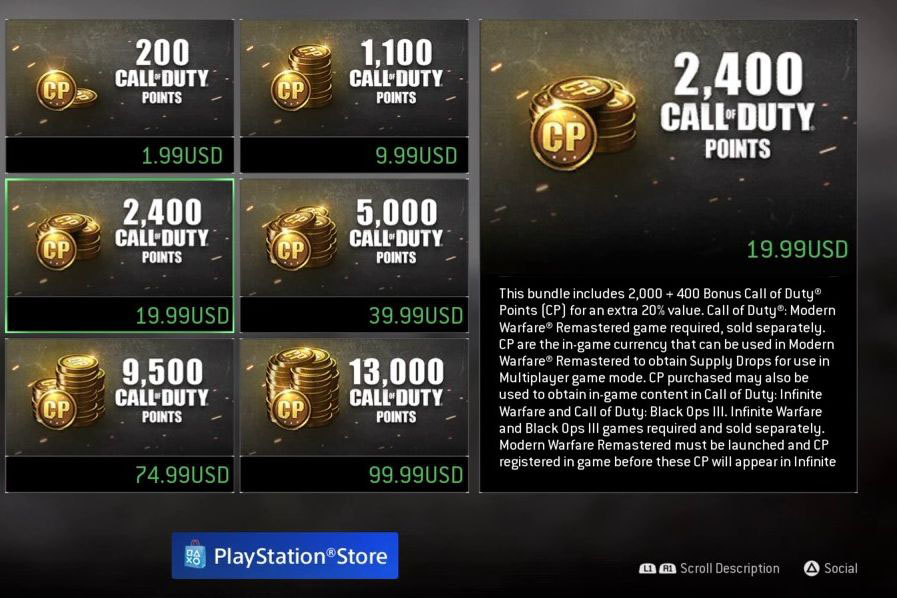
Microtransactions: a concept that has received plenty backlash from the gaming community due to its notorious presence in games. The notorious presence stemming from how companies force you to use these transactions or/and charge high prices for these in-game transactions. You would assume that the gaming community wouldn’t use the in-game transactions, as they know of its exploitative use, in order to boycott the system and force the companies to stop using the model or to lower the prices of the in-game transactions.
However, the behaviour exhibited by the gaming community is in fact the opposite, as the current model of in game transactions continues to exist and has worsened over the past couple of years.
This begs the question: Why do they continue to use the current model of in-game transactions knowing that its exploitative? Don’t they realise they’re being robbed?
Before we delve into the specifics in hope of finding an answer let’s first define a micro-transaction.
A micro-transaction is a form of game monetization that generates revenue from a game by offering some sort of benefit in exchange for money. On paper this doesn’t seem like a bad idea, the developers make some extra cash from their game and the player gains some sort of benefit. Though in reality, it isn’t this cut and dry.
Companies may offer game-breaking benefits, charge exorbitant prices or use methods that trick the player into making a micro-transaction, which is the main reason contributing to why the model continues to exist. (These tricks and why they work can be explained by using behavioural economics, which will be discussed later in the blog.)
The way developers use micro-transactions, as highlighted above, turns an idea, that could equally benefit both parties, into a cash-grabbing scheme for them and clearly affects the players in a negative way. Because of this, both players and developers will be discussed throughout this blog as they are the two major stakeholders.
However, some games that use in-game transactions are more acceptable than others. This brings us onto our 3 case studies: Freemium games, paid games with micro-transactions that don’t affect progress and paid games with micro-transactions that do affect progress. (Progress refers to the accessibility of future content within the game.)
Freemium Case Study: Candy Crush
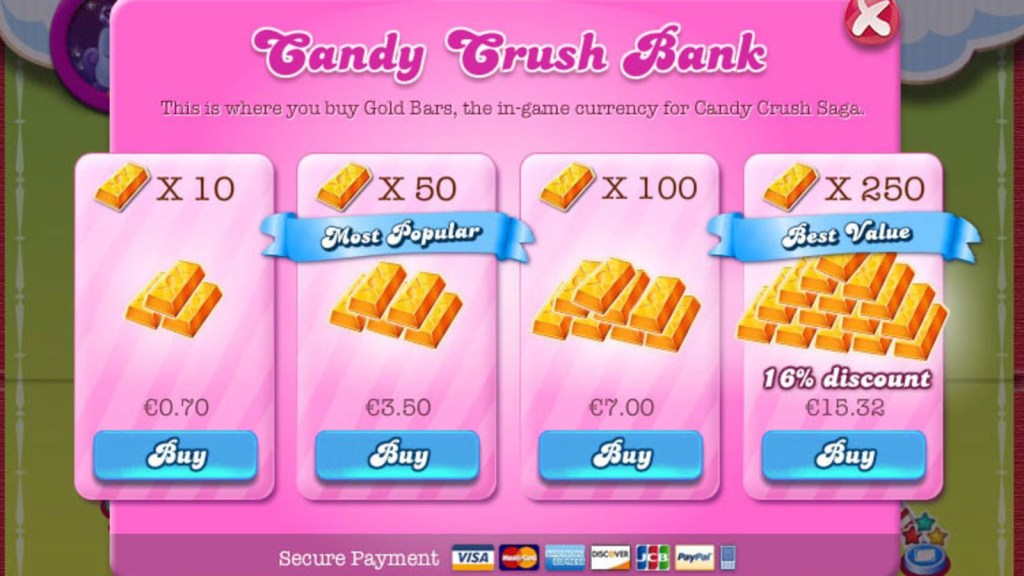
Freemium is the term used to describe games that can be played for free but require money to unlock additional features in the form of microtransactions. Generally, the use of micro-transactions in freemium games are somewhat acceptable, as the developers don’t make any money up-front and need a source of revenue. However, this need for cash plays a big part in the development of the game, as developers try to trick players into making a micro-transaction by using a variety of methods, such as hiding information or giving incomplete information. This is known as a coercive monetization model.
The most rational decision for any player with freemium games would be to not make any in-game transactions & just play through the game normally as they would (generally) still be able to complete the game without spending anything. They would still gain the same amount of benefits compared to if they paid money to speed up progress, as they both still access the same amount of content. If you were to compare both options, spending money loses out more as they could’ve accessed the content without spending anything.
But, due to the coercive monetization model, players in fact do spend money on in-game transactions.
Candy Crush is a great example of showing how the coercive monetization model is applied.
However, since we are trying to figure out why players make a micro-transaction, we must look at the homo economicus and, from there, look at the influences that make players act less like the homo economicus in order to find an answer to our question.
The homo economicus is the theory of the ‘rational economic man’ and is how traditional economics view an average consumer. Since it is a theory it makes some assumptions, to be exact four assumptions, about the average consumer.
Rationality: Consumers will maximise their utility and will make the decision that yields the greatest net benefit. Included under this assumption is that consumers will act as individuals and not be influenced by decisions made by others.
Ordered benefits: Consumers are able to rank all their preferences from the most net benefits to least net benefits.
Informed decision making: Consumers have access to all relevant and accurate information that will help in making their decision.
Marginal benefits from consumption: Consumers will experience less utility from each additional good or service consumed when compared to the utility gained from the previous consumption of the same good or service. i.e. the second pizza slice will give less satisfaction compared to the first one.
Since players don’t act like the rational man, it must mean that one or more of these assumptions aren’t true and this is where behavioural economics come in.
Candy Crush exploits and undermines the informed decision-making assumption, which in turn affects the rationality assumption. This is described as bounded rationality in behavioural economics where the consumers ability to make rational decisions is limited by the availability of information, the complexity of the decision, the brains cognitive limitations and time constraints.
-Premium Currency & Framing

The introduction of gold (a premium currency) is a tactic used to hide and muddle information shown to the player. Players use gold to then purchase the benefits within the game. This premium currency acts as a layer that makes it harder for the player to gauge how much they are spending for the benefit. This is an example of the framing bias consumers experience due to them taking mental shortcuts to make decisions.
Key Terms
Premium Currency: an in-game currency that can be obtained in exchange for real-life money
Framing bias: How options or propositions are presented
Let’s give an example to show how it is applied.
In Candy Crush, you play through levels that have goals. The player needs to meet these goals within a set number of moves. If you don’t meet the goals within the moves you lose, however you can purchase 5 additional moves for 10 gold. 10 gold costs around $2 in AUS.
Frame 1: 5 additional moves for 10 gold
Frame 2: 5 additional moves for $2
As you can see from this example, you would be more hesitant in paying $2 for 5 additional moves when compared to paying 10 gold as you know how much you are actually spending. This allows you to better weigh up the benefits and disadvantages so you can make a more rational choice. Because of this, developers will always opt for some version of Frame 1.
This technique is incredibly effective if more layers are added. For example, you can use gold to purchase another currency that allows you to purchase the 5 additional moves, making it even harder for the player to know how much they are spending.
In short, because the player is unable to accurately gauge how much is actually being spent, they do not have enough information to make a rational choice which undermines the informed decision making assumption and is a contributing reason to why the current in-game micro-transaction model continues to exist.
–Skill Game Vs Money Game & Anchoring
As the names imply, a skill game is one where skill is the main factor that determines your success and a money game is one where the amount you spend is the main factor that determines your success. For obvious reasons players prefer skill games over money games and Candy Crush subtly takes advantage of this.
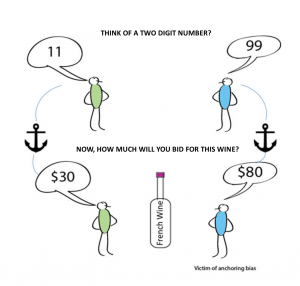
They do this by first anchoring the player in the early levels of the game. These levels are designed to be completed without having to spend a dime & they slowly increase in difficulty, but not by so much that the player would need to make a micro-transaction. This ‘anchors’ the player into thinking that the game is a skill-game.
Key Term
Anchoring: Consumers’ judgements are affected by some arbitrary starting value.
Eventually the game requires boosts to pass the level & forces the player to spend, making the skill-game into a money-game. Under normal circumstances the player wouldn’t spend, as they realise that the game is trying to force them to make a micro-transaction and would continue to do so for a while.
Though, as you can tell, these aren’t normal circumstances as the anchor takes effect and the player still thinks they are playing a skill-game. The player then judges (using their experience from previous levels) that the game just got a little more difficult for them and they’re just not skilled enough yet to beat it. This then encourages them to make a in-game transaction under the guise of ‘help’ so they can get past the level. They justify this purchase by thinking they’ll eventually become good enough to beat any future levels that share the same difficulty & that the current level is just a waste of time for them.
In short, the use of anchoring, in order to trick the player into thinking a money game is a skill game, results in important information (the skill-game being a money-game) being hidden from the player. This results in the use of a micro-transaction under the guise of it being more beneficial than it really is. (i.e. considering it as ‘help’ rather than realising they wouldn’t pass the level without it)
This undermines the informed decision-making assumption & rationality assumption and is a contributing factor to why the current in-game micro-transaction model exists.
–Reward Removal & Self-Control
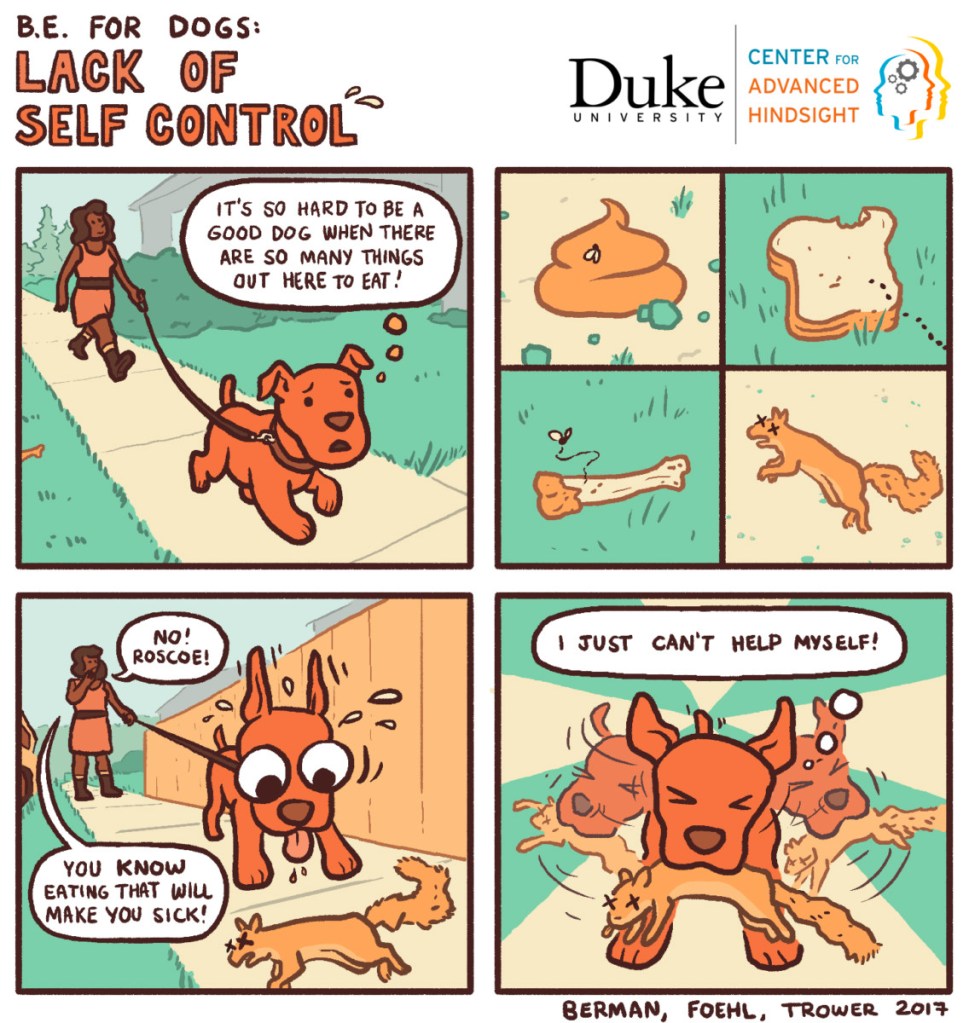
Reward Removal is a very effective technique as it abuses the lack of will power/self-control players have. The present bias & loss aversion are some aspects of human behaviour that developers target.
Key Terms
Present bias: Over-valuing the present and under-valuing the future due to factors such as over-confidence & procrastination.
Loss aversion: People’s tendency to prefer avoiding losses rather than acquiring equivalent gains.
This technique is used effectively in Candy Crush with special events they introduce. One of these events is called “Space Dash”. The more games you win in a row without losing the more boosts you gain, but if you lose, you’ll lose the boosts that you’ve gained.
This obviously is an application of reward removal, as they give the players boosts, they can use and threaten to take it when the player loses, unless the player pays for additional moves to finish the level. In addition, the longer the player has had these boosts, the less willing they would be to part with it. This is because the player has over-valued the present & prioritised immediate gratification rather than thinking about the actual decision due to the fear of losing something they have.
In short, the use of methods that abuse the lack of self-control players have, undermines the rationality assumption and is a contributing factor to why the current in-game micro transaction model exists.
It is clear after looking at Candy Crush, that the existence of in-game micro transactions in freemium games is attributed to the targeting of the many flaws and biases players exhibit.
The impact of the current model of in-game transactions on players is not good, as they are being tricked into making decisions they normally may have not made (or at least would’ve made knowing all the information and having complete control over their decision). Maybe stricter rules on in-game transactions may be needed in order to stop companies from immorally making money off players.
The next case study is a fairer application of in-game transactions that doesn’t result in as many exploits on the players biases and flaws.
Paid games (with micro-transactions that don’t affect progress) Case Study: Overwatch
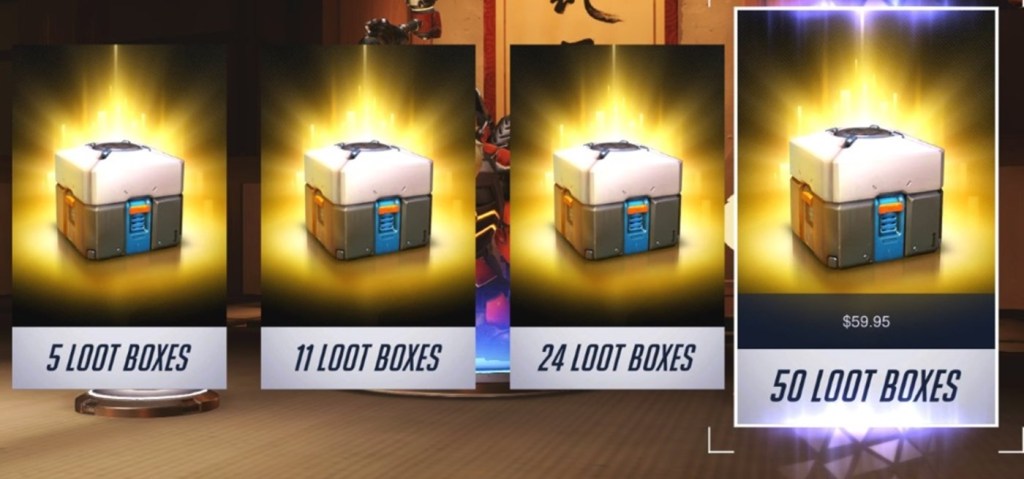
Overwatch is a team-based multiplayer first-person shooter developed and published by Blizzard Entertainment. Their application of in-game transactions is for loot-boxes which you can gain through levelling up or purchasing with real-life cash. Loot boxes are collectible items that contain a random selection of cosmetic items that can customize the in-game heroes. The rest of the content is free (after paying for the game up front). These types of models are the most acceptable since they offer some sort of benefit that doesn’t affect actual gameplay & doesn’t limit future content (more on this later).
The only main reason why this model exists is due to conspicuous consumption.
Key Term
Conspicuous Consumption: Consumption of expensive goods & services with the intention to publicly display their status
Since these cosmetic items are ranked from common to legendary, players, who want to demonstrate their status, will purchase hundreds of loot boxes in order to obtain the legendary cosmetics, so they can equip them in-game for everyone to see. Overwatch has multiple special event legendary skins that can only be unlocked for a specific period of time, which incentivises players to purchase loot boxes as levelling up and gaining loot boxes would take too long.
Overall, this model is the most beneficial for players as they don’t lose out on anything if they choose not to purchase. If they do choose to purchase, they are doing so with complete control over the decision and with all the information required clearly presented for them to make a rational choice.
The next case study, however, is the worst application of in-game transactions that all players frown upon.
Paid games (with micro-transactions that do affect progress) Case Study: EA Games & Star Wars Battle Front 2
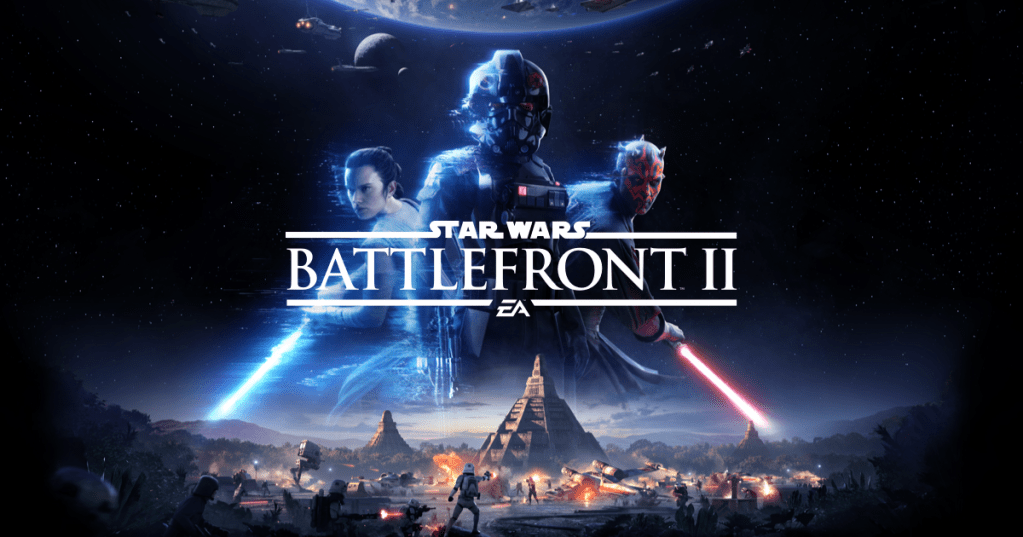
EA Games isn’t a game but a game company that develops games that are plagued with micro-transactions. Normally this would be somewhat acceptable if they were all freemium, but these are games that you pay for up front. EA Games has continued to produce these types of games for the last few years, indicating that people use the in-game transactions. Of course, the reasons mentioned beforehand do somewhat contribute to the use of in-game transactions, it doesn’t account for the fact that the players know they are being robbed silly. The only logical explanation that I can think of would be the sunk-cost fallacy.
Key Term
Sunk-Cost Fallacy: Continuing to invest resources into an activity because of sunk costs when it is in the consumers’ best interest to not do so. (Sunk costs referring to costs that have already been incurred and cannot be recovered.)
Let us use Star Wars Battle Front 2 as an example, which cost $80. In the game you can play as different heroes in multiplayer which can be unlocked using their in-game currency credits. You can earn credits from in-game play or through micro-transactions. This would be fine if it didn’t take 40 hours to unlock one hero and 300 hours to level it up to its maximum level (calculated by one of the players). The game was designed to force players into buying the heroes along with the very expensive price tag for the base game.
Because of the $80 the player first invests into the game; they continue to invest their time into believing that they’ll unlock all the characters eventually. After a period of time they realise that it will take forever to unlock one character but its already too late. They already invested hours and hours into the game and can nearly afford a character. Since they don’t want to lose out on the time they’ve invested, they purchase some credits in order to buy the character, investing more resources in the process. This becomes an endless cycle until the player runs out of money or until they finally give up on their sunk costs.
This doesn’t even account for the loot boxes you can purchase for credits which gives equipment for your characters.
This model is the worst one that exists in the market today as players are getting robbed blind without being able to do anything about it.
Conclusion
The gaming industry definitely needs a reform and/or a better set of regulations that prohibit the exploitation of players with micro-transactions. The unregulated use of methods that target the flaws in human behaviour in order to achieve maximum profit is terrible & is the only reason why the current model of micro-transactions continue to exist. Players should be able to make informed decisions and have complete control over these decisions without being manipulated in some shape, way or form.
As of right now developers & companies are clearly benefiting the most from the current status quo, while players are being left in the dust. When is it time for players to get the justice they deserve?
Bibliography
Candycrush.fandom.com. 2020. Candy Crush Saga Wiki. [online] Available at: <https://candycrush.fandom.com/wiki/Candy_Crush_Saga_Wiki> [Accessed 15 March 2020].
Gamasutra.com. 2020. The Top F2P Monetization Tricks. [online] Available at: <https://www.gamasutra.com/blogs/RaminShokrizade/20130626/194933/The_Top_F2P_Monetization_Tricks.php> [Accessed 15 March 2020].
Salla, R., Grinham, T. and Christies, C., 2020. Economics From The Ground Up. 3rd ed. Melbourne: Commerce Presentations and Publications.
Star Wars Battlefront Wiki. 2020. Star Wars Battlefront II (DICE). [online] Available at: <https://battlefront.fandom.com/wiki/Star_Wars_Battlefront_II_(DICE)> [Accessed 15 March 2020].
Wiki, O., 2020. Overwatch Wiki. [online] Overwatch Wiki. Available at: <https://overwatch.gamepedia.com/Overwatch_Wiki> [Accessed 15 March 2020].

 Year 11 MHS Economics 2020
Micro-transactions and their various models are something which players should take seriously before they dip into their wallets, making informed decisions before investing their money into the game. This isn’t to say that some companies and their models for micro-transactions aren’t bad or immoral, but perhaps ensuring that people make more informed decisions and really think about what they’re purchasing, getting as much information as they can before they make it is the best way to prevent themselves from being scammed. Companies which promote a “pay to win” play style can do so, however they should understand that what players want in the end, is to have fun rather than spend all their money. Bad models such as EA’s may not go away in the future, but we can still broadcast our message by boycotting the product, and encourage the business to not use such models. Hopefully EA learn from this one and think about their model before making their next game 😀
LikeLike