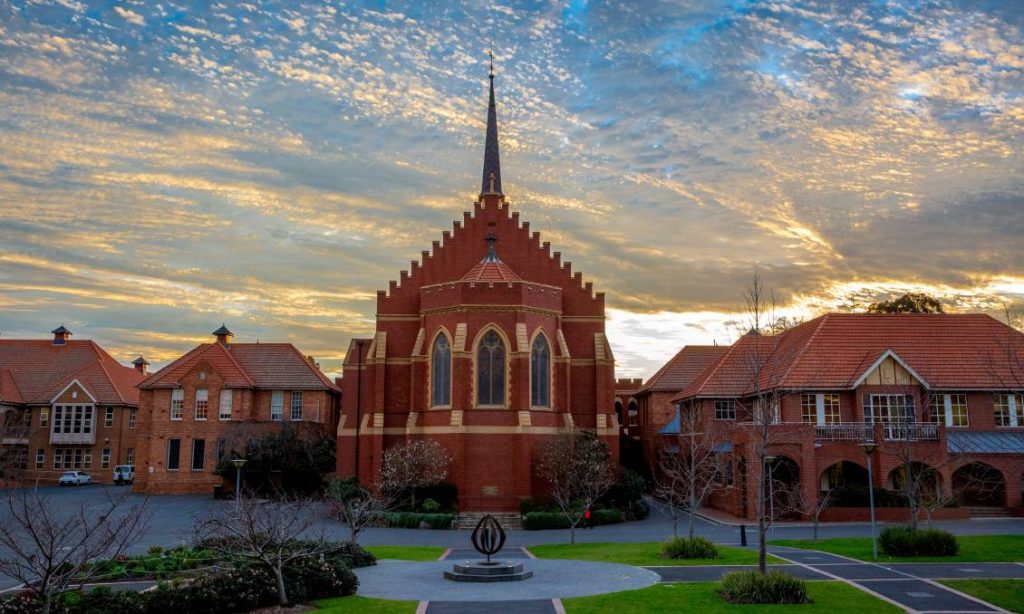
I go to a prestigious high school. I have very qualified teachers, more-than-decent facilities, classrooms and sporting grounds. I have an extensive co-curricular and sporting program, and I also have the expectation to do well in both my academia and my co-curricular endeavours, in an environment that pushes me to do well and excel in all my interests. But I don’t go to a private school. In fact, I go to a school that, in terms of yearly tuition fees, is worth roughly one-fifteenth of the average private school, but in terms of education, is probably worth the same, if not much more than the average private school. Yet, over 19% of Australia’s GDP is attributed to non-tertiary, private education, double the OECD average of 8%. Given the soaring costs that come with private education, this begs the question: why are more and more Australians willing to spend on independent education?
‘Education might be one of the most valuable things in life, but it’s also increasingly one the most expensive’.
Within the recent years, economic factors within our society have shifted. The cost of living continues to rise – the cost of housing continues to soar, prices for everything are inflating, and wage growth remains stagnant. For the average household, this means that the amount of money available to spend – disposable income – is slowly diminishing as there is little chance to earn more, but little chance to save as well.
The cost of education is no exception.
Within the last two decades, the enrolment fees of schools are ‘tripling’. Consequently, private education ‘costs a lot of money…and the average Australian household doesn’t have the disposable income it once did’. It costs the average Australian so much, in fact, the debt-to-income ratio for Australian households have increased in the 60-80% quintile. In layman’s terms, most Australians can’t afford independent education without going broke.

Let’s put this into a scenario. The average, nuclear, Australian household: two working parents, two kids. The median (the more ‘typical’ measure) household income for an Australian household is roughly $1616 a week, and that equates to about $84,032 a year. Now let’s say both of the family’s kids are in their secondary years of education, attending another Melbourne high-school: Melbourne Grammar, a prestigious private school. Annually, this would cost the family about $68,500 for both of their sons, where annual fees are around $34, 260 per child. That is just under 80% of the family’s annual income, and in terms of weekly spending, this means that the average Australian family would have little over $300 dollars per week to spend. The opportunity cost is immense – all the money spent there could have been saved, or used for other purposes that would also bring utility to the consumers.
On the other hand, the family has the opportunity to send their kids to another Melbourne-based high-school: Melbourne High School – a prestigious Government school. Annual fees are about $3000 per child, and as a result, the family will be paying $6000 per annum for their child’s education, at a school with an similar, if not arguably better level of education. On top of that, the cheaper cost of the education allows more disposable income for the family to use on other purchases, allowing for more financial freedom, and different ways to maximise consumer utility – entertainment, comfort, wants and desires.
Now, going by traditional economics, given these two options, both of which maximise the consumer’s – the family – utility, traditional economics would have us believe that the family would choose to send their children to Melbourne High School, as traditional economics states that consumers act in their own self-interests, and when presented with choices of the same thing, they will choose the cheapest option, as it is a rational and logical decision.
However, this isn’t the case in the real world.
In reality, for schools that charge over $20,000 per annum, enrolments have risen – a trend that has been continuing over the past couple of decades. This trend has lead to an overall increase in independent schools’ enrolments, as the diagram below depicts.

More and more parents are investing in private schools for their children’s educations, despite research finding that there are no benefits from studying at a private school. A study of kids from kindergarten to Year 8 in both public and private schools states:
‘It is worth noting how little variation school type really accounts for in students’ achievement.’
So, again, this contradicts the traditional economic assumption that all consumers act and make the best decisions based on their availability to perfect information.
This is where behavioural economics comes in.
If we were to use the same scenario again, where a family is choosing between keeping their children at Melbourne Grammar or send their children to Melbourne High, chances are, according to current statistics, people will remain at the private school. This is likely due to some behavioural economics which explains why consumers do make irrational decisions, contradicting traditional economics:
- Conspicuous consumption, where a consumer is more concerned about displaying wealth or power. Obviously the notion that sending your kids to a rich, elite private school is a bit of a flex, but considering the fact that most private school students come from affluent areas in a city, this would definitely sway the parents’ decisions if they are living in the area, as the underlying assumption is that ‘private schools are good investments, public schools ruin your kids’;
- Bounded rationality, where a consumer is unable to make a rational decision because of the complexity of the decision, and the biases within the consumer. In this case, the decision is like choosing between a top-end BMW or a good, reliable Toyota – both options are good decisions – they get you where you need to go, but it depends on how you drive. Additionally, the emotional and social bias derived from parent’s perspective on private and public schooling would definitely have some impact on the parent’s rationality in this decision;
- Vividness, where a consumer is more likely to listen to a friend, or someone they share a personal connection with. I certainly would not send my child to a $30k a year school unless a friend told me about how good it was. This same logic and reasoning also applies to parents in this scenario. Over 53% of parents are known to have chosen schools based on their consultations with friends and family.
These are the likely reasons behind why, given the information we can access, Australians send their kids to independent schools despite the lack of concrete evidence stating that there is a benefit that independent schooling has over public schooling. They cost more, they are becoming increasingly pricier, and frankly, there are better ways to spend your money, rather than on a school with flashy buildings. In my opinion, if you want your kids to do well in school, a support network of good teachers and mentors is the way to go, not two heated olympic swimming pools.

 Year 11 MHS Economics 2020
A very interesting take on private vs public education. Well done!
LikeLike
Great level of detail – what a huge change we’ve seen in Australia since 1970!
LikeLike
Still missing the Zimbabwean hyperinflation crisis, but some good analysis and reasoning as to why parents send their children to private schools.
But, on a more serious note, I think that the comparison between private schools and MHS is a bit unfair, considering not everyone can go to MHS. Imagine if parents were tossing up over Werribee Secondary or Melbourne Grammar.
LikeLike
wow that is very expensive! 😍👍
LikeLike
Fantastic article Anhphi! I particularly liked how you broke down the average family’s expenditures and showed how much of their income private schools can really take up.
LikeLike
Great article Anh Phi, private schools are indeed very expensive, but I’m not convinced on the points that there is no difference between sending your kids to a private school as opposed to a public school. There is a huge variation between different the quality of schools both private and public, but nonetheless a great read.
LikeLike
Really good analysis as to how behavioural economics applies to our daily lives, especially for something as essential as education.
LikeLike