
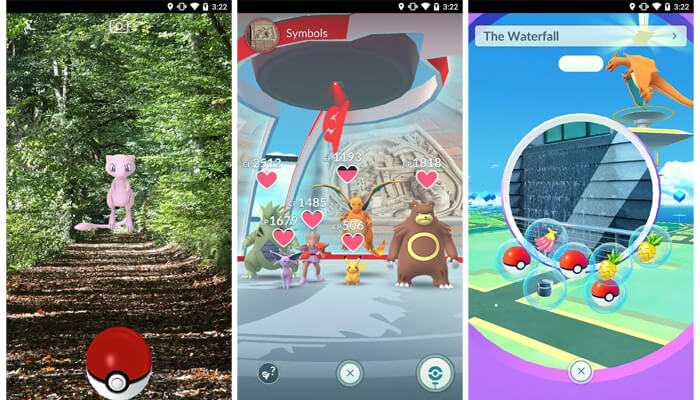
While apps such as Facebook, WhatsApp and Snapchat dominate the screens of many Australians, developer Niantic changed the mobile app scene in 2016 by introducing a new virtual reality game into the market; Pokémon Go. The game entails the phone user walking around a map which represents the real-life environment and catching ‘Pokémon’. The app also uses camera to make it seem as if the Pokémon is in the outside environment.
Some notable achievements include 20 million daily active users, 65 million monthly users and a total revenue generated of $1.2 billion, as of July 2017. It has a total of 752 downloads, as of March 2018, and a retention rate of almost 60% (if the user still uses the app after a certain amount of days), whereas the average gaming app is only about 15% after three days. Over the first month of release, Pokémon Go received 10 million dollars’ worth of in app purchases (spending real money on in-game bonuses). Other large-scale gaming apps such as ‘Candy Crush’ receives a revenue of about $0.2 per user where Pokémon Go receives about $0.25 per user.
In terms of domestic economics (economy of one’s own country), Pokémon Go has been more successful in its country of origin, the United States. With one of the highest retention rates, with 34 million downloads and 30 million continuing to play it one month after download, this has resulted in Niantic having a total revenue of $607 million in America only.
Internationally speaking, the game is also available to other countries such as New Zealand, Australia and countries in Europe and Asia. In terms of all-time spending, users in Japan (spending $500 million), Germany (spending $96 million) and England (spending $77 million), are ranked 2nd, 3rd, and 4th respectively also.
Niantic was able to achieve such a high revenue due to multiple factors, such as their use of framing and opportunity cost to their intended demographic. While having many users across different age groups, the main demographic playing the game was men between 21-27, the shop which allows for purchases using the in-game currency or real-life money. The game often has sales and sells the items in bulk. Framing is changing the way a object is presented to make it seem more appealing to the consumer. In the shop, “Poke balls” are sold in bulk, rather than in small portions. If they were sold single, the deal would seem less appealing to the customer and hence reduce their revenue. They also arrange all the non-real-life money items at the top of the shop, making it seem as if everyone can buy these items, inducing consumers to spend on the game.
References:
2020. [online] Available at: <https://www.washingtonpost.com/local/pokemon-gos-augmented-reality-is-augmenting-the-reality-of-this-small-town/2016/08/13/b39cd6f2-5e1d-11e6-8e45-477372e89d78_story.html> [Accessed 16 March 2020].
2020. [online] Available at: <https://www.mobileappdaily.com/2018 /07/27/pokemon-go-revenue-statistics> [Accessed 16 March 2020].
Camoinassociates.com. 2020. Economic Impact Of Pokemon Go | Camoin Associates. [online] Available at: <https://www.camoinassociates.com/economic-impact-pokemon-go> [Accessed 16 March 2020].
Schwartz, G., 2020. 3 Major Marketing Insights From Pokemon Go. [online] Entrepreneur. Available at: <https://www.entrepreneur.com/article/279404> [Accessed 16 March 2020].
Wong, J., 2020. We Finally Know How Much Nintendo Made From Pokémon Go. [online] Quartz. Available at: <https://qz.com/819677/nintendo-pokemon-go-profits-we-finally-know-how-much-nintendo-made-from-pokemon-go/> [Accessed 16 March 2020].

 Year 11 MHS Economics 2020
It is very interesting to know how games where it seemingly does not require payment of any sorts to make money. Very informative indeed.
LikeLike
Quite a unique topic, it was informative and the explanation of how game companies still make money even if their game is free was very interesting.
LikeLike