
MMT
Modern Monetary Theory or MMT is being as the miracle cure to all economic ailments. It fundamentally challenges the way we perceive money in our current world. It completely disregards our traditional viewpoint of “debt = bad, surplus = good” and this is a pill that’s hard to swallow. So what actually is Modern Monetary Theory.

A Brief Introduction to MMT
Modern Monetary Theory (which I will henceforth refer to as MMT) is a macroeconomic theory under the assumption that the federal government of a country has a complete and natural monopoly over the currency used within that particular state. This means that the government is the only body that can ‘print’ money (the majority of new money is digitally created rather than printed). It explains that governments have a different relationship with debt than a household or business does with the key point of difference being that governments have the ability to print its own currency giving it essentially unlimited money. But hang on. What about inflation? Wouldn’t this just result in hyper-inflation with your money becoming worthless? Yes, yes but we will get into that a little bit later.
A good way of conceptualizing this radical theory would be to imagine you and your family acquired a magic money printer that is able to print 1:1 exact copies of banknotes. Well you would probably start printing a ton of money to first pay your bills, mortgage, student loans and credit card debt. Okay, well now that you’ve done that, you can start printing a bunch more money to buy a new car, new tv, new phone and make a bunch of decisions that will improve your quality of life. So if you think about a budget deficient as the amount of money you spend being greater than the amount of money you make (your regular non-money printer income) then you’ll notice that you may have accumulated an absurdly large deficient. Although you and your family have a large budget deficient, it doesn’t seem to be impacting your quality of life in anyway at all.
A key reason that debt is viewed as a non-issue by MMTers is because sovereign debt is held and paid in a state’s own currency therefore by printing new money a state can never go bankrupt.
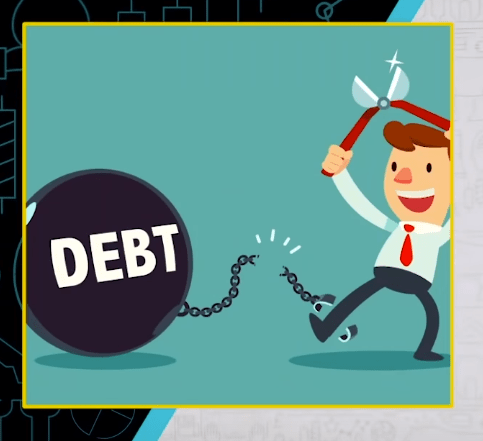
What makes MMT so miraculous?
So back to the government. This analogy demonstrates that a government can use their money printer not only to repay debt but also to improve material living standards for its citizens. Not only this but MMT could also be the answer to market inefficiencies such as those seen in the labor market. A government could create money to fund new jobs so that a country maintains a healthy unemployment rate meaning that productive capacity will increase. In fact this healthy unemployment rate could basically be 0% because these new government jobs would be paying minimum wage thus maintaining a healthy competition for higher paying jobs. This would also reduce our societal reliance on the welfare system (another inefficiency).

So debt doesn’t exist, deficits mean nothing and anything and everything can be funded. OK, then what’s the catch?
THE FLAWS OF MMT
Inflation
The bane of MMTers, inflation is a word thrown around by every skeptic of MMT. We already know that inflation is the term used to refer to a general increase in the prices of goods as services denoted by a fall in purchasing power. We also know that inflation is usually caused by increased spending, whether it be government spending or consumer spending, and it’s also caused by increasing the supply of a currency (reducing its scarcity and devaluing it). It is only reasonable to assume that the excess money that will be created subject to the whims of governments following the principles of MMT will cause massive levels of inflation potentially even hyper-inflation.
So what’s the “solution” to this seemingly impossible problem? Can we increase the value of a currency?
Taxation
Taxes?!
I know, I know. You must be thinking what on earth do taxes have to do with MMT. Well taxes have the unique and crucial ability to increase the value of a currency. The Australian government only collects taxes in AUD not USD or bitcoin or gold or any other currency/commodity. The fact that you can only pay your taxes in AUD creates an inherent demand for the currency and effectively forces those residing in that country to use and save one particular currency.
Taxation creates what some say is artificial demand for a currency because the demand is created by the government and can be manipulated. For example, if a government raises taxes, it would increase the value of a currency.
In this way MMT is a complete backflip on the monetary relationship between governments and citizens. Instead of everyone earning and collecting money and then paying taxes to the government which the government uses to fund its activities, governments now print money to fund government projects which the population then needs to collect the money to pay government taxes which is now reduced to a means of stabilizing the value of currency rather than a means of income for the government.
In fact, tax dollars could even be destroyed or incinerated to further increase the value of the currency (by increasing the relative scarcity of that currency and therefore increasing the demand).
Although this new way of thinking is very innovative and ideal, high taxes and incineration of money is not exactly what you would call a popular election policy and this is why I have listed it as a flaw of MMT.


Incinerating money on mass will not seem like good idea for most members of the public.
Another challenge to MMT presented by taxation is a governments ability to effectively tax big multinational companies. Without the ability to effectively tax these companies it will now result in inflation of a currency. This issue is explained in more detail in my previous blog post.
Politics of Monetary Policy
Let’s face it. The average person is dumb. Most everyday Australians simplistically assume that government budgets are the same as household budgets where a surplus is achieved by making more than you spend and a deficit is achieved by spending more than you make. If the Australian government said that they would raise taxes to 70-90% there would be rioting in the streets. In fact, the Coalition’s main election pitch was to bring back a budget surplus, and this proved hugely popular amongst voters.

Given the all-importance of populism in today’s political landscape, MMT is an extremely unlikely and ‘fringe theory’. If its principles were to be adopted, it would need the support of both major parties and bi-partisanship on monetary policy is not something we are accustomed to.
MMT Doesn’t Work for Some Countries
Some countries are unlucky and will never be able to reap the benefits of MMT either because they don’t print their own currency or their currency is so unstable and volatile that no sane creditor would hold debt or accept repayments in that currency. An example of such a currency is the Congolese Franc (CDF) which is used in the Democratic Republic of the Congo; because of the nature of the CDF, their government is forced to incur debt and make repayments in a reserve currency which is usually US dollars. This creates even more demand the USD. Other countries, particularly pacific island nations, completely ditch a local currency in favor of US dollars also heightening demand for the USD.
Additionally, many countries are not capable of printing their own currency anymore. Famously, most EU countries lost their sovereign right to print their own currencies after joining Eurozone and converting to the Euro in 2001. EU member states cede some of their sovereignty in favor of the collective strength afforded by the EU.

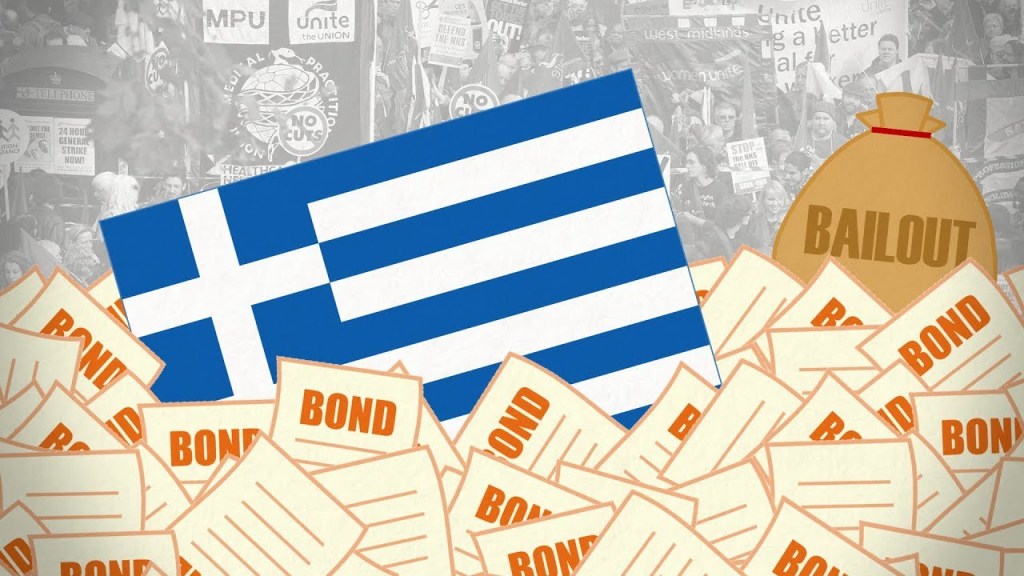
The Greek sovereign debt Crisis would never have occurred if Greece was still able to print the Drachma, their currency prior to 2001. They could have simply paid of the debt by printing more cash and incurred the costs of inflation instead of the chaos that ensued instead.
Impact of Banks in the Creation of Money
Another shortfall of MMT is that it assumes that governments hold a monopoly over their currency printing. Unfortunately this is not true. In fact you might be surprised to know that banks create more credit than governments in most developed countries. You might be thinking its a bit silly that banks can also create money but they do need some real funds to justify the credit they create. Although the credit created by banks is not the same as actual money printed or created by governments, it has the same effect in that it can contribute to inflation.
This fact just makes it more difficult for governments to control inflation levels and therefore does not ‘help’ MMT.
MY OPINION
In the past, many critics of MMT are quick to point out the MMT is hard to prove due to limitations regarding mathematical modeling surrounding the theory. This has traditionally been the Achilles Heel of many big macroeconomic fringe theories since you can’t really test a theory on an economy because if it fails it could spell disaster for many people. However this is no longer true (to a degree) because the government of Japan have been utilizing the principles of MMT since the 1990s. Today, Japan maintains a Debt to GDP ratio of over 200%, the highest in the developed world. Many argue that the development and technical advancement that the Japanese enjoy today is in no small part thanks to the expansionary monetary policy that followed the principles of MMT.
Considering that Japan was the world’s guinea pig, I think that MMT certainly has its place in the world potentially being able to improve living standards for billions of people. Unfortunately for us it still has many shortcomings which are yet to be solved such as the ever present inflation dilemma and the secondary issue of some states being incapable of practicing MMT.
I think we won’t be seeing MMT be a mainstream idea in monetary policy in the near future for some of these reasons but mainly due to its lack of political versatility and domestic appeal. I sincerely hope I’m wrong about this though, because if its advocates are right, then MMT has the capability to change the course of human development.
I think the critics are right when they say that MMT is more of an insight into the workings of contemporary economies and the concept of money in today’s world than it is the miracle cure its made out to be.
GLOSSARY
Bankruptcy- a legal proceeding where an entity is unable to repay debts to creditors.
Budget Deficit- exists where government spending exceeds government revenue in a fiscal year.
Budget Surplus- exists where government revenue exceeds government spending in a fiscal year.
Currency- the monetary median of exchange within a country.
Debt-to-GDP– a ratio comparing a country’s debt to its total Gross Domestic Product (GDP).
Eurozone– official called the euro area it is the union of states that use the Euro as their sole currency.
Hyper Inflation- Inflation occurring at an extremely rapid rate.
Inflation- a general rise in the prices of goods and services denoted by a decrease in purchasing power.
Labor Market- refers to the supply and demand for labor.
Macroeconomics- a branch of economics concerning an economy as a whole in contrast to an individual actor.
Market Inefficiencies- a situation where a market does not operate as well as it could.
Monopoly- exists when a singular entity is the sole supplier of a good or service to the market.
Natural Monopoly- a monopoly that exists where the market structure of a monopoly is the most efficient allocation of resources.
Productive Capacity- the maximum possible output of an economy.
Purchasing Power- the amount of goods and services that can be bought per unit of currency.
Sovereign Debt– debt incurred by a country’s government that cannot be minted by the country owed to external creditors or other countries.
Taxation- the practice of a government collecting money from economic actors operating within the state’s borders.
Unemployment Rate- the percentage of people seeking work that are unemployed.
REFERENCES
Connors, L. and Mitchell, W., 2020. Framing Modern Monetary Theory. [online] Core.ac.uk. Available at: <https://core.ac.uk/display/47200719?source=4> [Accessed 2 September 2020].
Explained, E., 2020. Modern Monetary Theory: How It Could Answer All Of Our Economic Problems. Available at: <https://www.youtube.com/watch?v=N8HOWh8HPTo&t=616s> [Accessed 27 August 2020].
Hamada, K., 2020. Does Japan’s Experience Vindicate MMT?. [online] The Japan Times. Available at: <https://www.japantimes.co.jp/opinion/2019/07/07/commentary/japan-commentary/japans-experience-vindicate-mmt/> [Accessed 2 September 2020].
Horan, P., 2020. 5 Problems With MMT. [online] Mercatus Center. Available at: <https://www.mercatus.org/bridge/commentary/5-problems-mmt> [Accessed 2 September 2020].
Mohamed, T. and Edwards, J., 2020. Bernie Sanders Is Being Advised By A Fan Of An Economic Theory Called MMT: Here’s A Plain-English Guide To What It Is And Why It’s Interesting. [online] Business Insider Australia. Available at: <https://www.businessinsider.com.au/modern-monetary-theory-mmt-explained-aoc-2019-3?r=US&IR=T> [Accessed 14 September 2020].
Murphy, R., 2020. City Research Online – Tax And Modern Monetary Theory. [online] Openaccess.city.ac.uk. Available at: <https://openaccess.city.ac.uk/id/eprint/23060/> [Accessed 2 September 2020].
Sumner, S., 2020. Why A Hot New Idea In Economics Is Actually A Bad Idea. [online] Mercatus Center. Available at: <https://www.mercatus.org/bridge/commentary/why-hot-new-idea-economics-actually-bad-idea> [Accessed 2 September 2020].

 Year 11 MHS Economics 2020
Please don’t read this. It seems as if most of my blog has been deleted. I will try and restore it soon.
*Edit- Fixed!
LikeLike