
To understand why we should use alternative measures of living standards and why GDP is not a good indicator, we must first master the definition of GDP. A country’s Gross Domestic Product is the final market value of all finished goods and services produced in its economy over a period of time (usually measured per year). GDP is used as the main indicator when comparing living standards across countries, however it is a bad indicator and leaves much to be desired.
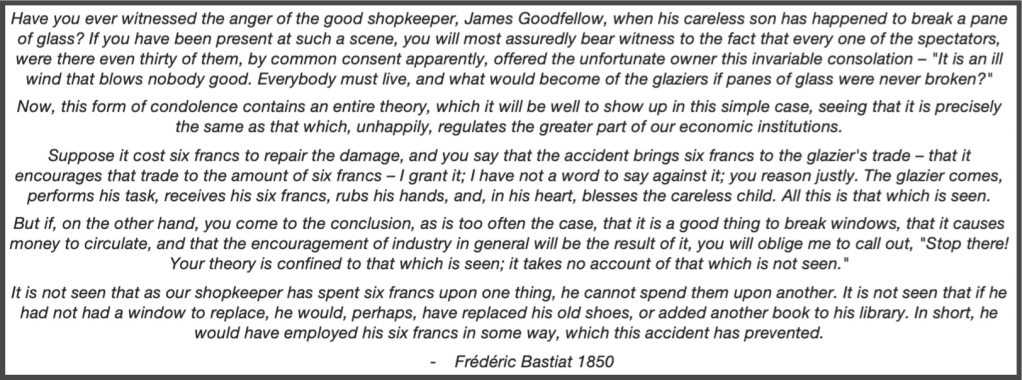
GDP is not fit to be the sole indicator of a nation’s living standards, as it only measures said nation’s income and does not account for many other factors. It can be misleading if used as the sole indicator of a country’s living standard. For example, it can increase after a natural disaster, such as an earthquake, since large sums of money will be spent rebuilding. This was summarised by a French economist named Frédéric Bastiat (also known for introducing the concept of opportunity costs), as the parable of the broken window. It describes an increase in one sector of the economy, having a ripple effect which impacts other economic sectors.
Alternative measures to GDP are usually either material or non-material living standards. Material living standards are generally tangible and/or affected by income and economic growth, while non-material living standards are harder to measure and affected by factors not directly linked to income and economic growth.
While one’s opinions of living standards will depend on their view of what a satisfactory society should encompass, the following standards are typically considered as suitable alternative measures to GDP.

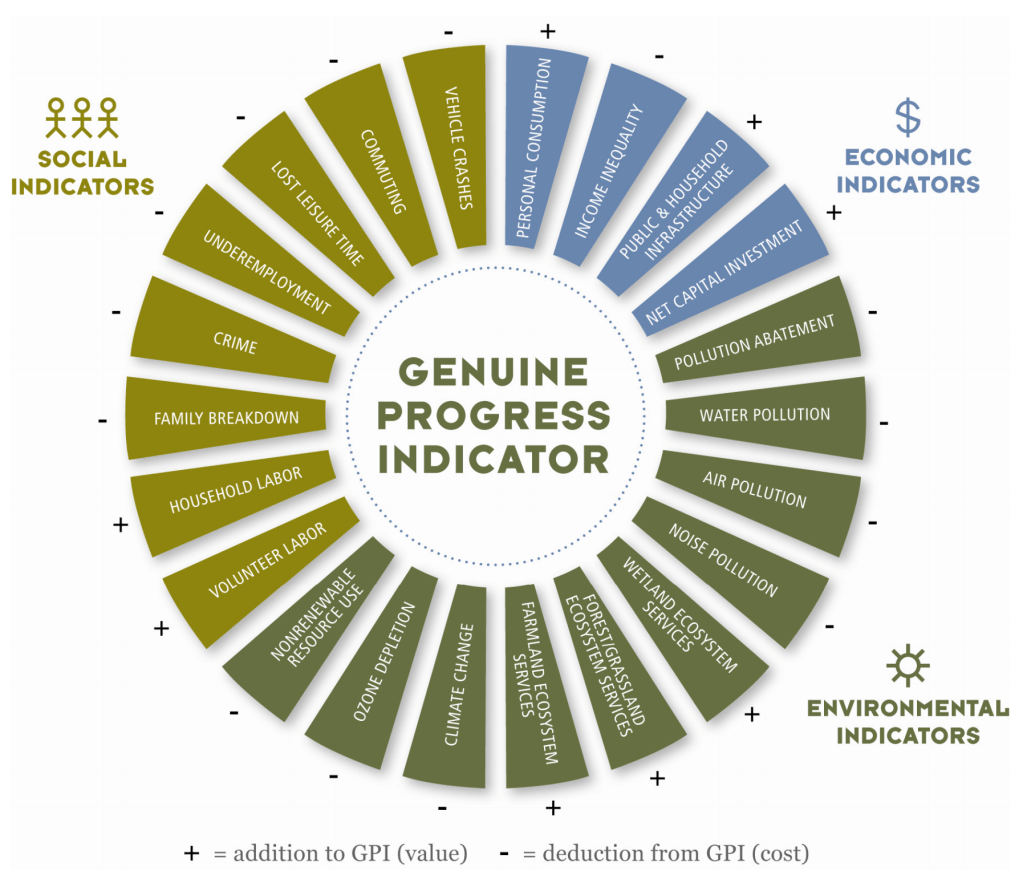
Genuine Progress Indicator: GPI is one of the most popular alternative measures to GDP, especially within environmental and green economics. It counts the data used in calculating GDP, along with 25 other indicators, including cost of pollution and cost of crime. GPI was created with the intention of improving the ease and understandability of accounting for the wellbeing of a country. Its creator, Herman Daly, once said, “there is something fundamentally wrong in treating the earth as if it were a business in liquidation”. Daly’s work on the ISEW (Index of Sustainable Economic Welfare) and GPI has earned him countless awards and it is clear to see why GPI is one of the forerunners in replacing GDP.
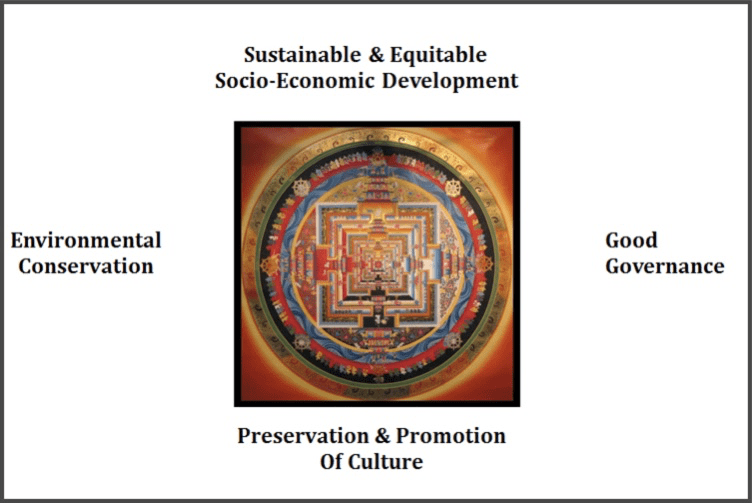
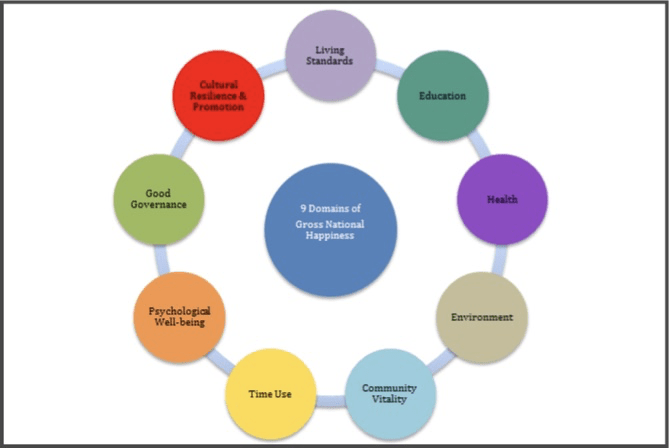
Gross National Happiness: GNH is a measure of the overall happiness of a nation’s population, using four pillars, broken into nine domains, shown below. It was first conceived in an interview between King Jigme Singye Wangchuck and a British journalist in 1972, when the king announced that “Gross National Happiness is far more important than Gross National Product (GDP)”. It is used to describe four different groups of a population by happiness, and later analysed to discover potential policies which would increase happiness levels in the lower components of said population. While initially it may not sound like a reliable indicator, GNH is actually quite complex, accounting for factors such as health, education, community vitality and environmental diversity.
.
.
Human Development Index: HDI is a measure of a country’s social and economic development. It was created by Mahbub ul Haq of Pakistan and is used by the United Nations. Its components can be summarised into three main areas: life expectancy, education and income (GDP per capita from resident citizens). It is quite basic and has less components than other indicators, however gained popularity since it is used by the United Nations and is fairly easy and cheap to gather data when compared to other indicators such as GPI and GNH.
The three measures of living standards mentioned above are all more complex and accurate than GDP, as they not only include the same data, but add other factors relevant to a nation’s living standards. All three are good indicators and would be able to replace GDP as a suitable standard of living.

FAQ:
Why do so many people and countries around the world still use GDP as a measure of living standards?
People are obsessed with economic growth and think an economy must have a constantly rising line of growth. They believe that GDP growth is the sole indicator to a strong national economy, pressuring governments to continue trying to increase the value of their economy. Kate Raworth, creator of doughnut economics, says this is because “we are socially addicted to growth, thanks to a century of consumer propaganda”.
How can we move towards using alternative measures of GDP?
I believe that the usefulness of GDP will have diminishing returns, as inflation continues to grow, even if real GDP is used, it is not wholly accurate. Alternative measures of living standards are starting to be used by more countries, especially in the past 20 years, so hopefully indicators such as GPI, GNH and HDI will be more widespread in the coming years. However, it would not hurt to educate others on the benefits of alternative measures to GDP.
Key Points:
- GDP should not be used as the sole living standard for a country.
- Rather it could be used in conjunction with other living standards, or as a component of one, such as in GPI.
- Other living standards such as GPI, GNH and HDI should be used, since they more accurately account for the wellbeing of a population and nation.

 Year 11 MHS Economics 2020
References:
[1]Economics from the ground up, A text for students of VCE Economics Units 1 & 2 – 3rd Edition
[2]https://theconversation.com/beyond-gdp-are-there-better-ways-to-measure-well-being-33414
[3]https://en.wikiquote.org/wiki/Simon_Kuznets#:~:text=The%20welfare%20of%20a%20nation,a%20measurement%20of%20national%20income.&text=Distinctions%20must%20be%20kept%20in,short%20and%20the%20long%20term.
[4]https://www.khanacademy.org/economics-finance-domain/macroeconomics/macro-economic-indicators-and-the-business-cycle/macro-limitations-of-gdp/a/how-well-gdp-measures-the-well-being-of-society-cnx
[5]https://www.investopedia.com/articles/economics/08/genuine-progress-indicator-gpi.asp
[6]https://www.investopedia.com/ask/answers/08/broken-window-fallacy.asp
[7]https://en.wikipedia.org/wiki/Parable_of_the_broken_window
[8]https://www.ted.com/talks/kate_raworth_a_healthy_economy_should_be_designed_to_thrive_not_grow/transcript
[9]https://ophi.org.uk/policy/national-policy/gross-national-happiness-index/
[10]https://gnhusa.org/genuine-progress-indicator/
LikeLike