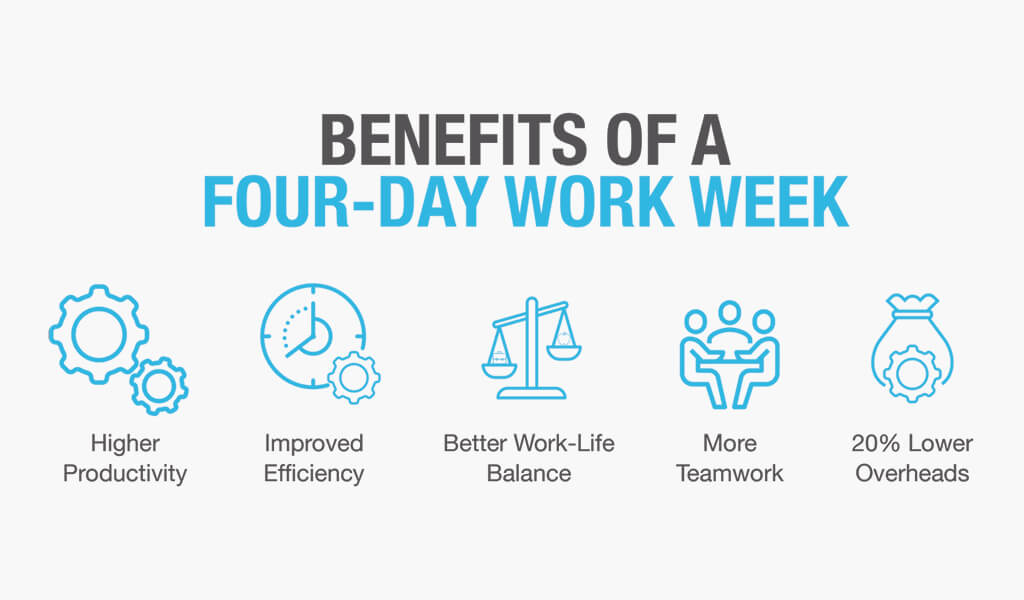
The contemporary business model of the four-day work-week is not a new concept. Reading about the Finnish Prime Minister’s ‘Aspirational Goal of a 6-hour, 4-Day Work-week’ led me to a 2019 Case Study involving UK Businesses, that estimated that a four-day working week could save upwards of £104 billion (over $200 billion AUD), and that two-thirds of the sampled business reported an increase in staff productivity. This then prompted me to investigate the most cited case-study (that of Microsoft’s subsidiary in Japan), which piloted a four-day work week and reported a 40% increase in productivity.
From that point, I found myself thinking: is a 4-Day working week the key to productivity in businesses?
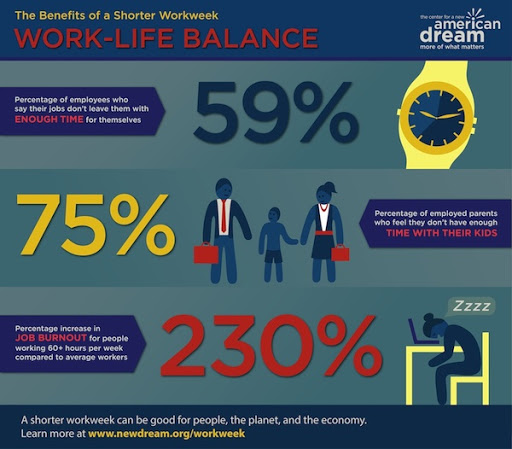
The concept stems from modern business owner’s straying away from the longer shifts, fewer breaks, workaholic culture that was believed to lead to economic success (more input of hours equaling greater output).
However, after some research and observation, business-owners (including New Zealand businessman Andrew Barnes) realised that the efficiency of the firms’ labour resources (i.e. employees) could be increased if more time and money were spent on their morale and well-being. The business would trade-off a paid working day, for each of their employees to spend on other life-endeavours (and/or Netflix bingeing), in return for greater productivity on their work days. For each business that experiences an increase in productivity, their ‘curve’ of production moves in the positive direction. (i.e. they are more technically efficient)
So that’s it isn’t it? Governments should mandate a four-day working week and all stakeholders come out on top?
Unfortunately, it isn’t that simple.
Four-day work weeks often have the converse effect on productivity and profitability, especially for small businesses and start-ups that do not have the ‘person-power’ to cover lost shifts, retain clientele and complete day-to-day business activities. In financial terms, this means owners require greater numbers of employees, and end up paying an additional salary for the same amount of work. This, combined with the uncertainty of increased productivity of employees (and risk of decreasing work-ethic), suggests that the extra weekend may not be a universal business-hack that increases productivity.

Now, you may ask, is it beneficial or detrimental to implement a 4-day working week? Well, no real economist (or informed person) would give you a definite answer. There is no, nor should there be, a set working model for service and trading businesses. Working models should be tailored to suit the company and the economic climate in which it operates. Smaller businesses may find other means of ‘de-stressing their employees’, and growing (and large) businesses may choose to implement the four-day model to retain their talent (or demand more working hours in a weaker economy, where less jobs are available).
Although cutting hours does not guarantee an increase in productivity, it is in a company’s best interest to retain employees (especially in a competitive economy) and manage their worker’s well-being to gain the productive edge over their counterparts. If larger companies implement this model, will they gain an additional advantage in the labour market – will this feed their Monopoly over other companies? How will small-businesses mitigate the trade-offs associated with the four-day working week? What will a typical working week look like in the next decade? Businesses will need to answer these questions in order to avoid lagging behind in the progressive economy of this new generation of workers.
The bottom line is, work-life balance is an investment that businesses MUST make in the modern economic and social climate, and to do this, “[they] need to think about work in a fundamentally different way“.


 Year 11 MHS Economics 2020
I suppose that in todays climate this is a relevant issue, especially with employers looking to increase their productivity and thereby there profit or efficiency
LikeLike
The contemporary business model of the 4 day working week or an equivalent is certainly something that businesses and companies should consider implementing. Whilst not a universal model, it’s a potential solution considering the progressing economy and changing economic culture.
LikeLike