The world’s two largest economies are going head to head in a battle of the ages, and America and China are not the only two countries affected by this.

Due to the low cost of Chinese imports and what Trump would say were ‘unfair prices’, domestic manufacturing could not compete with the costs of Chinese imports, as wages for employees in China were far less expensive than American wages, so the cost of producing the goods were much cheaper in China. In 2018, President Donald Trump set a tariff on Chinese imports to promote and encourage domestic produces.
In response, China has devalued the Yuan to counter Trump’s tariffs, so that the US would continue buying exports from China, and have also imposed retaliatory tariffs on US goods for a similar value. So who is actually winning this war, and who are affected by this?
China
China’s economy has experienced its lowest economic growth numbers in twenty-seven years. It’s economy has taken a 0.25% hit. Although it is at its lowest economic growth, it is still at a whopping 6.1%, which is significantly higher than other leading economies, including the US, which has a projected growth of 2.2%. In fact, the 6.1% growth rate is within the 6%-6.5% target range from the government. Statistics show that although there have been substantial tariffs on Chinese goods, they have maintained 75% of exports to the US. This could be due to China devaluing the yuan, so that prices are still enticing for the American economy.
Many companies who originally had manufactured goods in China, are moving their manufacturing process to other countries like Vietnam, Taiwan and Mexico, where there aren’t any tariffs, so imports would be cheaper. Many giant companies such as Sony Mobile have moved their manufacturing divisions elsewhere. This results in large numbers of low-paid factory workers to lose their jobs, as the manufacturing process has moved elsewhere. It is estimated that the trade war has caused 700,000 to 1,200,000 jobs lost.
United States
Tariffs on American goods from China have negatively impacted America’s aviation, automotive and agricultural industries. An example of this is the soybean industry. China by far, was the biggest importer of soybeans. Ever since the tariffs have been put in place, more than half of the soybean inventory has gone to waste. This has resulted in many farmers being forced to shut down their farms, as they were losing money, and are unable to generate a sustainable profit.
As a result of this, President Trump has been under the gun and has not been a fan favorite of many people, including the farmers who have been forced out of a job as a result of the trade war. Although the majority of Americans agree that China trades unfairly, most support free trade and oppose tariffs.

American consumers and companies have also seen the negative effects of the trade war. The tariffs on certain products have caused an increase in price on many goods. Since the start of 2018, we have seen products like speakers, furniture, clothes and electronics increase in price. This is because imports of equipment have been hit with a tariff, which have forced companies to lift the prices of their products. An example is the audio industry, which sees more than half of the equipment coming from China being forced to increase prices as a result of a 25% tariff on audio equipment in 2019.
How has the Trade War affected other economies?
Although there are certainly countries that are negatively affected by the ripple effects of the trade war, there are also countries that benefit from the results of the trade war. There countries are the low-cost exporters, such as Vietnam, Taiwan, Japan, Mexico and others. This is because companies are moving distributions from China to other low-cost exporters to avoid the tariffs so that they can keep the prices low. Aside from the minority of winners, there have been significant negative impacts on the global economy, and many other countries have been caught in the crossfire.
The global growth has slowed down to 3% which is the slowest pace in a decade. This could be partially due to the trade war. It is important to note that a trade between China and USA doesn’t only happen between these two countries. It can happen in a web of global economies, where goods are manufactured in different companies. This is called the global supply chain. An example of this is the manufacturing process of an apple phone. A lot of the manufacturing process happens in China, but also a lot of other countries as well. So when the manufacturing process is disturbed, the other countries will be affected as well. An example of an economy that has been affected by the trade war is Germany.
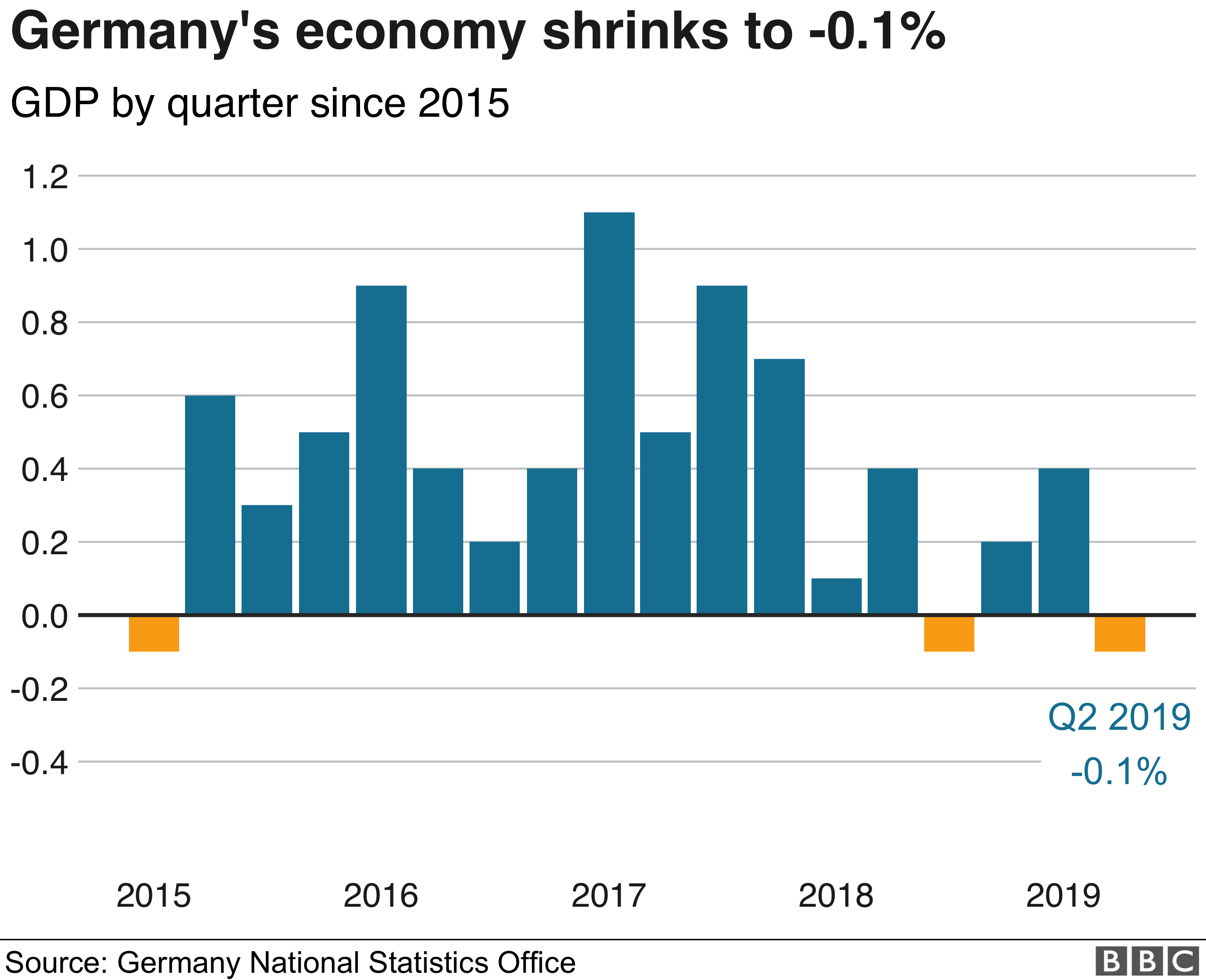
Germany, who has in previous years been Europe’s most reliable economic engine, is close to a recession due to the trade war. Germany is heavily reliant on exports, which amount to almost half of the German economy, at 47%. With the trade war happening, the Automotive industry has taken a hit. This is because both the US and China have import duties on cars, meaning that the number of cars sold is decreasing.
Personal Opinion and hypothesis?
In my opinion, I believe that currently, both countries are facing significant repercussions of the trade war, and that an agreement will be made in the near future to reestablish fair trade among these two countries, because if the trade war continues to happen, we could see both countries economic growth to continue to slow down. With the introduction of the corona virus outbreak, I believe it will be extremely difficult for China to balance both issues, which is why I believe that China may seek to form an agreement with the United States to improve trading relationships between the two countries.
If the trade war continues to happen, it will be interesting to see who will come on top, and who will surrender. In my opinion, I believe that China has the upper hand in the long run, because the US is dependent of the low-cost goods that China can provide America, whilst China has a more developed domestic market, which allows them to continue to flourish without having to purchase American exports. Many US industries like the agriculture industry is also reliant on Chinese purchases, and are unable to function without them. For the US, consumer goods prices will continue to rise indefinitely, until the trade war stops, because the cost of producing goods will increase, which will increase the price of the goods in the market.
Therefore, my hypothesis is that China and the US will reach an agreement in the near future about the agreement of free trade, as China has a lot to handle right now with the corona virus, and America is also losing out heavily, as they are receiving less purchases for American goods. At the end of the day, it is a lose-lose situation for both countries if they continue this trade war, and will even negatively impact the global economy.
Connection to economics
The trade war is connected to economics because it substantially impacts the global economy, and the way money is moved around the globe. The tariffs also have the potential to decrease the economy’s production possibility curve, as economies are not as efficient as a result of the rising prices of goods and services within the economy, which will result in less demand for the goods, and less manufacturing of the goods.
Bibliography
https://www.bbc.com/news/business-48256535
https://en.wikipedia.org/wiki/China%E2%80%93United_States_trade_war#Overall_effects_on_U.S._economy
https://www.bbc.com/news/business-51353503
https://www.worldatlas.com/articles/10-cheapest-countries-to-ship-exports-from.html
https://unctad.org/en/pages/newsdetails.aspx?OriginalVersionID=2226
https://www.institutmontaigne.org/en/blog/germany-and-us-china-trade-war-stuck-middle
https://www.investopedia.com/insights/how-would-trade-war-affect-you/
https://europe.autonews.com/blogs/trumps-china-trade-war-escalation-bad-news-german-automakers

 Year 11 MHS Economics 2020
Very intriguing article!
LikeLike
Great analysis of many of the different stakeholders in the global economy, particularly the analysis of the German economy who many would see as largely irrelevant to the direct trade war but was still affected. Good work on the description and explanation of the global supply chain, which shows how individual trade relations, particularly between large nations, can have a ripple effect throughout the world.
LikeLike
The impacts of the trade war on both America and Japan are described in great detail here. Very informative
LikeLike
Nice, discussing the standpoints for both countries. Good objective view.
LikeLike