
“Get off your phone!”
You’ve probably heard an angry boomer bark this at you before.
But what implications does the online world, particularly social media, have on the economy and by extension, our lives at large?
The Attention Economy
Before we can truly grapple this question, we need to establish the idea of the ‘attention economy’.
The attention economy: an economy in which human attention is treated as a scarce commodity.
In an attention economy, human attention is the universal currency and the more of it you have, the wealthier you are.
Think about it.
The longer you can gauge someone’s attention, the easier it is to sell something, market a product, create a need or gain data.
For this reason, technology companies have found innovative and efficient ways to keep you hooked online so they can gain more data and market more products. Digital technology, in particular social media, has been meticulously engineered to grab your attention and keep it.
Attention is by far the most efficient way to produce profit for two reasons:
- Companies can sell products to CONSUMERS
- Companies can sell data to BUSINESSES
Look at this graph:
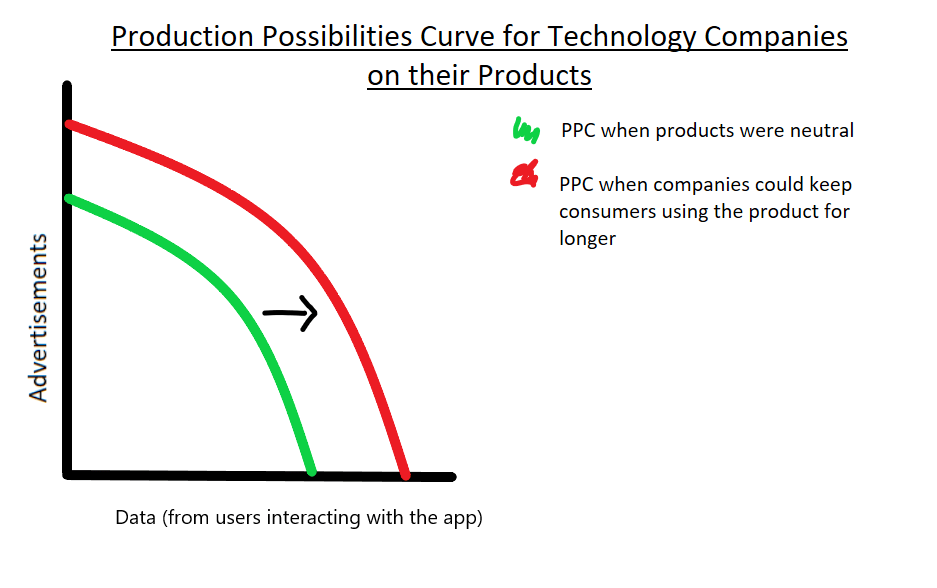
The green line represents the technological efficiency possible by companies when technology was neutral (when companies didn’t intentionally design their products to make them addictive). There was a limitation on how high they could go. The red line shows their productive possibilities once they were able to keep users hooked for longer, giving them more time to advertise and more data.
As a result, their increase in productive efficiency led to them being able to sell more and thus, see an increase in profit, revenue and sales. By extension, because these companies are such large players in the economy, they were able to consolidate more economic strength and thus, drive the economy by offering jobs, investing in projects etc.
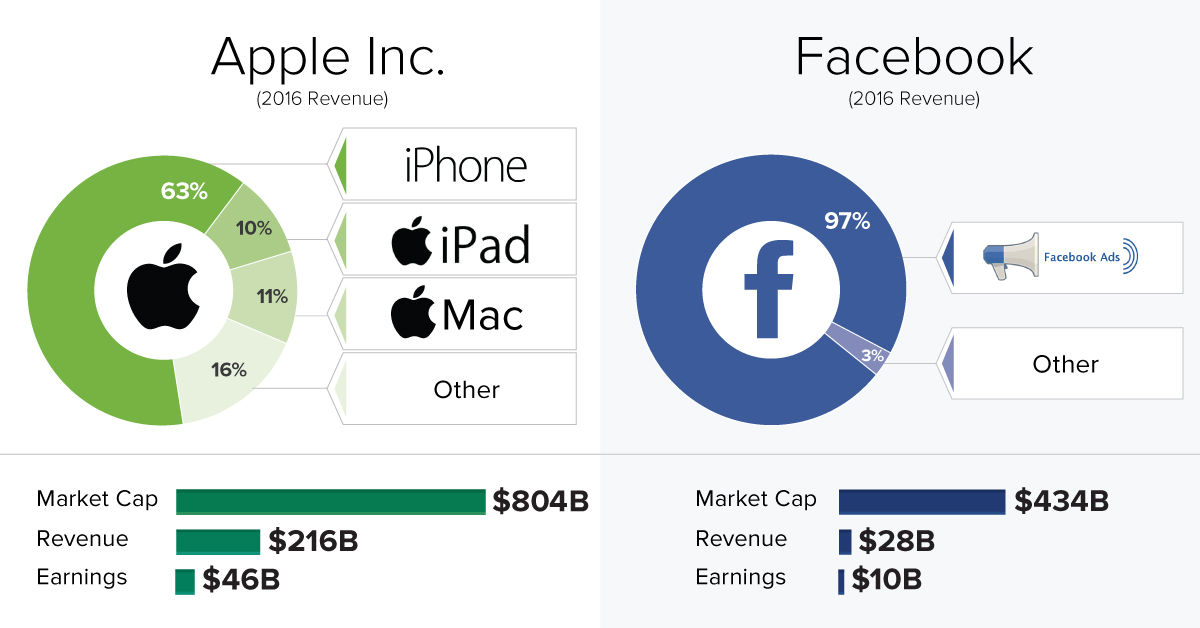
For the first time ever, digital technology enabled for businesses to sell information to other businesses more efficient than ever. Over time, the data became more valuable than the advertising and before we knew it, Silicon Valley’s attention engineers were flying into tech companies finding ways to steal your time.
Consumer Decision Making and Tech
In Cal Newport’s book, ‘Digital Minimalism‘, the specifics of how and why attention has been procured by companies so they’re able to sell big data is further explained.
“People don’t succumb to screens because they want to, they succumb to their screens because of billions of dollars have been invested to make them as such”
Cal Newport- Digital Minimalism
Companies have invested millions into finding the best ways possible to manipulate how long users spend on their products. Features such as kinaesthetic appeal, colours of tools on screen and other design elements have been used to keep you hooked. This is purely due to how unbelievably profitable selling information to businesses is.
“Companies didn’t spend millions of dollars on tweaking and improving things such as the like button and the direct message notification because they felt it was crucial to the essence of their product. They did it because it gives you more of their time”
Cal Newport- Digital Minimalism
As a result, the more data they had, the more money they could make. The only way for such tech businesses to increase their data without increasing their user base is to keep you on their devices/software for longer.
“Technology is not neutral, companies want you to use their products for as long as possible to make themselves money”
Cal Newport
Now this idea may seem relatively simple at first glance, but upon deeper inspection, we can see that the notions these companies subscribe to are the same principles underlying modern economics (as opposed to traditional economics).
The key bias that technology companies manipulate is present bias.
Present bias: the human tendency to overvalue to present moment and undervalue the future (often driven by the need for immediate gratification)

Tech companies have hired psychologists and behavioural economists to maximise the pleasure that their devices bring in the present so that individuals choose to sacrifice any future consequences it may bring.
For example, the red notification sign you receive on Facebook or Instagram are intentionally designed so that you choose to engage in the app rather than do something else more productive (study, work, exercise etc). This is why people feel as if time flies when they go on their devices, because the constant appeal that their phone/laptop and the apps on it bring are too attractive for our brains to resist. As a result, users spend more time on their products and less living their desired life.
Another key idea of modern economics that such companies follow is the idea that consumers are irrational. Traditional economics would argue that consumers use cost benefit analysis on each decision they make and try to maximise their utility by being as rational as possible- this is simply wrong and the usage of technology and social media shows this better than ever.

As discussed above, users choose to go on their phones to watch other people’s lives for hours rather than living their own, users intentionally chase the gain of as many followers/online friends as possible rather than intentionally trying to improve/strengthen their current relationships and users spend MORE of their actual life on products that are ‘meant’ to allow them to live more of their actual life.
No ‘rational’ person would scroll through videos of people lip syncing to music when they should have been doing their economics homework.
No ‘rational’ person would spend hours researching how to have an ‘aesthetic’ Instagram feed so they have more followers and clout than their friends when they could have spent that time exercising, spending face to face time with their friends/family, studying or doing literally anything else more productive.
Our irrationality drives the revenue of these companies.
I personally don’t like to antagonise these companies because ultimately, they’re just trying to maximise their profit. In the macro sense, what they’ve done is unethical, but I don’t think they even predicted how much of a societal shift in behaviour their products would bring. This is seen by how even the CEOs of these companies send their kids to tech free schools.

Regardless, I am very cynical on how technology affects my generations ability to be connected. But in a sense, these companies need to continue to operate at their size in order for the economy to be strong.
As explored in this page, investment and expenditure by technology companies creates jobs, increases efficiency and provides an array of other benefits that enable the economy to grow.
It’s hard to conclude whether their operations are ethical.
On the one hand, in order to increase their revenue, they need more data, which results in them getting consumers (us) more addicted to their technology. This leads to society as a whole living less full, enriched lives and instead, spending time on their screens being psychologically manipulated.
On the other hand, by increasing their revenue, these companies boost the economy, boosting the wellbeing of its citizens.
Conclusion
I firmly believe that scrolling is the new smoking and the damage this has on my generation will be realised when it’s too late or not at all. My study in economics has further enabled me to see how these decisions are linked directly to consumer behaviour and the assumptions by which these companies operate under.
It will be interesting to see how the effect tech has on society and the economy progresses as time carries on, but for now, it seems like the boomers aren’t going to stop complaining at us anytime soon.


 Year 11 MHS Economics 2020
Very interesting post, Jeevan, I definitely agree with you on the premise of your blog. Our time is more important than ever, as these companies spend billions to optimize their features to rewire our brains for their benefit. The ability to stay focused, shy away from distracted and get to the things that matter as Cal Newport states in his book Deep Work, will be duly rewarded by employers and consumers.
LikeLiked by 1 person
It was interesting to read this article, and I’m glad to have spent my time doing so. What do you think is the most effective way to counter-act the mesmerising effect of our devices?
LikeLike
Hi Ben!
I think the best way to tackle online addiction is unique to each person. But in general, you should analyse what you use, why you use it and if there is a substitute whatever it is with a less addictive thing. Considering you are an average teen, I’d recommend cutting out social media that enables you to ‘explore’ or ‘scroll’ as it is by far the most destructive and manipulative of all the tools designed to addict you :).
LikeLike