

The “decoy effect“, or also known as the “Asymmetric Dominance Effect”, is a behavioural cognitive bias where consumers will change their preferences of 2 choices, when presented with a third that is “asymmetrically dominant.”
So what does that mean in plain terms? It means that people tend to change their choices when buying a good or a service, when they are given a 3rd choice that is clearly inferior to the others. Generally speaking, in real world examples, the decoy effect results in consumers choosing the more expensive option when there is a 3rd inferior choice.
So, its plain to see why companies and marketers would love to use the decoy effect. After all, they’re getting more money without spending any money! It’s a win-win situation!
But how do consumers fall for these tricks, you say? Wouldn’t it be obvious that it’s all just a scam? To see how it all works, lets look at some examples.
Example. 1: The Economist
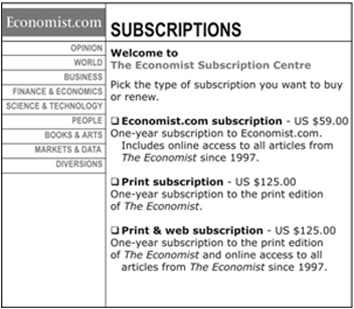
This is perhaps the most famous example of the decoy effect is the pricing structure of The Economist. In the photo above, it can be seen seen that The Economist has 3 pricing options. A digital only for $59, a print only for $125, and a digital and print for $125. Behavioural economist, Dan Ariely carried out an experiment using this pricing structure. First, he gave his student all three options, and he found that out of a 100 students;
- 16 chose the first option.
- 0 chose the second option
- 84 chose the third option
But when he removed the second option, even though no one chose it, the results changed dramatically.
- 68 chose the first option.
- 32 chose the second option.
If we convert that to actual sales, The Economist is making more than $3000 more for just 100 people.
So that’s one example of the decoy effect. What’s that you say? This is an old example? You would never fall for this, an incredibly intelligent Melbourne High student? That the experiment must have been held at Werribee Secondary College?
Well, here’s another example that I am 100% sure all of you would have fallen for.
Example. 2: Apple
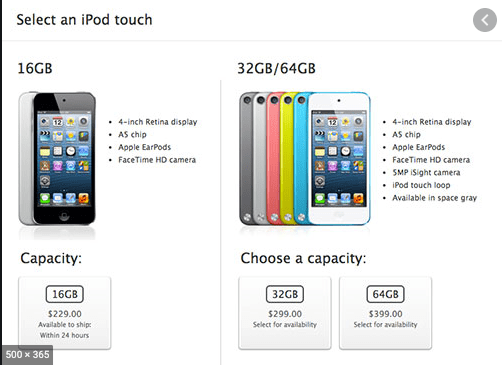
Yes, Apple is a brilliant exponent of the decoy effect as well. Ben Kunz explains it using their IPod range.
Decoys explain why Apple often sells each gadget in a pricing series, such as the new iPod Touch’s $229, $299, and $399 price points for different storage capacities. You may gladly spend $229 to get a hot media player, thinking it’s a deal compared with the highest-priced version and not blink that you could instead buy an iPhone 4 at the lower price of $199 with more features.
But it isn’t only limited to Apple. Countless companies, even your local supermarket, which means that its almost impossible to avoid. But how does it actually work?
How the Decoy Effect Works
No matter how much traditional economists try to persuade you, no human is perfectly rational. We all make cognitive mistakes and shortcuts, and the decoy effect takes advantage of that. When consumers are faced with a lot of choices, they experience "choice overload", a phenomenon which increases anxiety and hinders decision making.
In order to overcome this feeling on anxiety and doubt, consumers tend to relieve their stress by focusing on a few specific characteristics of a product, most commonly the price and quantity of said product.
Decoys created by companies take advantage of this, and aim to steer you into making a decision that benefits them most, while giving you the impression that you are making a rational and completely informed decision.
The decoy effect therefore is a form of nudging, which can be controversial in its ethical implications. Is it morally acceptable to alter people's opinions artificially if it means the ends are noble? Personally, I believe that decoy effect and nudging is perfectly acceptable, when presented on the basis of truthful information. I believe it is only morally unacceptable when companies and businesses start to use false information in order to nudge or deceive a consumer.
So next time, when you're buying a product, ask yourself, is this really the most rational choice you could make?

 Year 11 MHS Economics 2020
Very nice way to structure your conclusion. There is emphasis on every word, giving the sentence as a whole, alot of importance. I applaud your work. 👏👏👏. Also a nice way to stop the reader from accurately guessing your word count. Also very important.
LikeLiked by 1 person
awesome work aliyan!! 💖👍
LikeLike
thanks haden!
LikeLike
It is always interesting to examine the intricacies of human behaviour when it comes to economic decision-making. Why do consumers think they’re getting ‘the best deal’ when paying MORE for a good or service that can be obtained at a lower price? The conflicts (and resolutions to these conflicts) between consumers and producers are what drive transactions, and the Decoy Effect suggests that consumers are not entirely sovereign in a market economy.
Very interesting topic Aaliyan!
LikeLike
Thanks Pranit!
LikeLike
This is really interesting. I remember hearing another example of this effect when students are given the option of attending a lecture of an individual they admire or studying in a library, they choose to attend the lecture. However, if we are given two good options such as seeing a movie that you’ve been looking forward to, attending the lecture or studying, we instead default to studying because we can’t choose between two good choices. It seems our choices are very irrational, great blog 🙂
LikeLike
Thanks Khoi!
Exactly, humans tend to make very irrational decisions quite often, despite being the most rational beings on the planet!
LikeLike