
In 2017 the federal government legislated that Sunday penalty rates would be lowered by 15% every 1 July for 4 years, starting on the 1st of July 2017. Sunday penalty rates before the cuts sat at 190% of the normal award rate, and once they are completed penalty rates will lie at just 150% for full and part-time employees [6].
These cuts will affect over 700,000 workers, mainly those in the retail and hospitality industries. Once fully implemented the average Sunday worker will be $2000 worse off every year, leading to up to $1.64 Billion in lost wages [7].
“We want to hear from ordinary Victorians about how this decision will hurt their ability to earn a decent wage and look after their families.” Dan Andrews
On the surface, this might look like shameless pandering to the wealthy and business owners by the liberal government, but on paper at least these cuts do have a purpose. Wage growth has been slowing for years now in Australia and has been accompanied by decreases in consumer spending, which have hit small businesses hard, especially in the retail sector.
The Logic behind the cuts was that by reducing penalty rates on Sundays, small businesses, in particular, would hire more people on Sundays, and give existing employees more hours, increasing employment and keeping businesses profitable.
So what actually happened?
As far as change was concerned, almost nothing. ABS statistics show almost 0 growth in Hospitality and Retail industry employment since 2015, as can be seen in this graph [4].
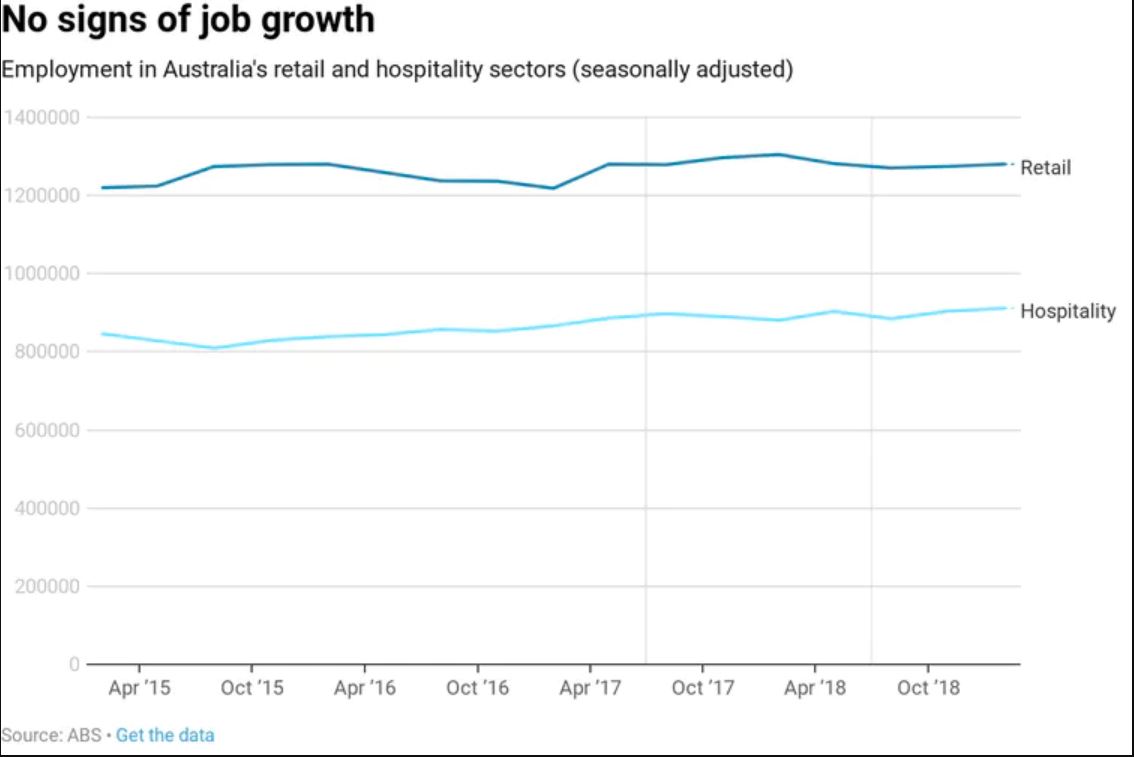
The small business lobby of Australia, which helped push for cuts in the first place, admitted that they saw no increase in hours for those already employed as well. On the surface it looks like the policy was a tremendous failure, costing workers billions in wages but bringing little growth in return. This, however, is a foregone conclusion.
The Sunday penalty rate cuts coincided with an increase to the minimum wage, on which penalty rates are based, of 3.3%. Due to this increase, despite the cut in penalty rates, the average worker only makes $12 per shift on a Sunday. This coupled with average consumer spending growth averaging just 0.1%, the lowest since the GFC, and well below the inflation rate of 1.6%, has left businesses worse off now than before the cuts. This does not mean once again that the cuts have failed, it simply means that the goalposts of the penalty rate cuts have shifted from increasing employment and business profits, to keep people in work and businesses afloat.
So once again, are the rate cuts worth it? If they are keeping businesses afloat and people in work, then almost certainly, as even wages paid with lower penalty rates are better than no wages at all. But then again the cuts completely failed their original goal, and there are probably more effective ways of keeping businesses afloat without cutting the wages of workers.
Overall, the penalty rate fiasco has shown that statistics and logic can be used to prove almost any point from any side. Both for and against opinions on this issue are completely rational and backed with statistics. This highlights the difficulty in critical thinking and getting to the truth on an issue in today’s age. In today’s world, a lack of perfect information is more of an issue than ever, and it’s only getting worse.
https://www.pedestrian.tv/news/penalty-rate-cuts-2019/ [1]
https://www.abc.net.au/news/2019-06-20/penalty-rates-are-about-to-fall-again/11225686 [3]
https://www.fairwork.gov.au/pay/penalty-rates-and-allowances/penalty-rates-changes-2017 [6]
https://www.sda.org.au/unfair-penalty-rate-cuts-hit-retail-and-fast-food-workers-for-the-third-time [7}

 Year 11 MHS Economics 2020
Epic idea, in a world where statistics are increasingly becoming used, misused and twisted, the sudden surge of information caused by the internet doesn’t seem to get us any closer to perfect information
LikeLike